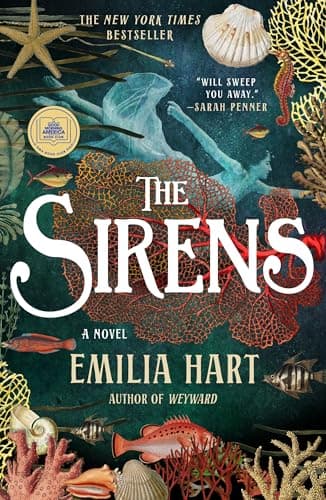
Should you read The Sirens?
What works
Lucy's fear, Jess's disappearance, historical women, and coastal folklore give bodily change a family history rather than treating it as an isolated supernatural event.
What may not work for you
The timelines do not carry equal urgency, and the eventual convergence relies on recognizable family-secret patterns beneath the novel's striking imagery.
What may test your patience
The historical strands interrupt Lucy's immediate search before their relation to the sisters becomes sufficiently concrete.
Does the ending reward the effort?
Mostly. The emotional inheritance resolves more satisfyingly than every mechanism behind the folklore.
Reading The Sirens closely
The Sirens follows Lucy to her sister Jess's isolated house on the Australian coast after a frightening episode at university. Jess is missing, Lucy is troubled by vivid dreams, and local history points toward women whose lives and disappearances have long been tied to the sea.
Emilia Hart moves between contemporary sisters and women separated from them by centuries. Family mystery, historical hardship, bodily change, and sea folklore gradually converge in an atmospheric story about inheritance and the stories used to contain women.
Four sisters across time
The timelines build echoes around separation, survival, and the ocean. The mystery depends less on rapid clues than on recognizing what one generation has passed to another.
For readers of Weyward
Both novels combine women's history, family pain, nature, and subtle magic. The Sirens shifts its element from land to water and gives sisterhood the central role.
Three useful comparisons
Bury Our Bones in the Midnight Soil
Bury Our Bones is darker, more erotic, and explicitly vampiric; The Sirens is gentler and organizes female transformation around sisters, ancestry, and water.
Best for: Adult readers wanting sapphic vampires, historical settings, nonlinear structure, sensual prose, violence, hunger, toxic intimacy, and meditations on freedom.
The Forest on the Edge of Time
The Forest on the Edge of Time also links family inheritance to a living landscape, but through climate and time travel rather than marine folklore.
Best for: For readers who want reflective climate fiction about family and stewardship, with less interest in airtight time-travel mechanics or constant action.
The Night Circus
The Night Circus offers denser spectacle and romantic enchantment; The Sirens is quieter, more domestic, and shaped by unease along one coast.
Best for: Readers who prioritize immersive atmosphere, visual magic, and slow-burn romantic mood over firm rules or fast narrative movement.