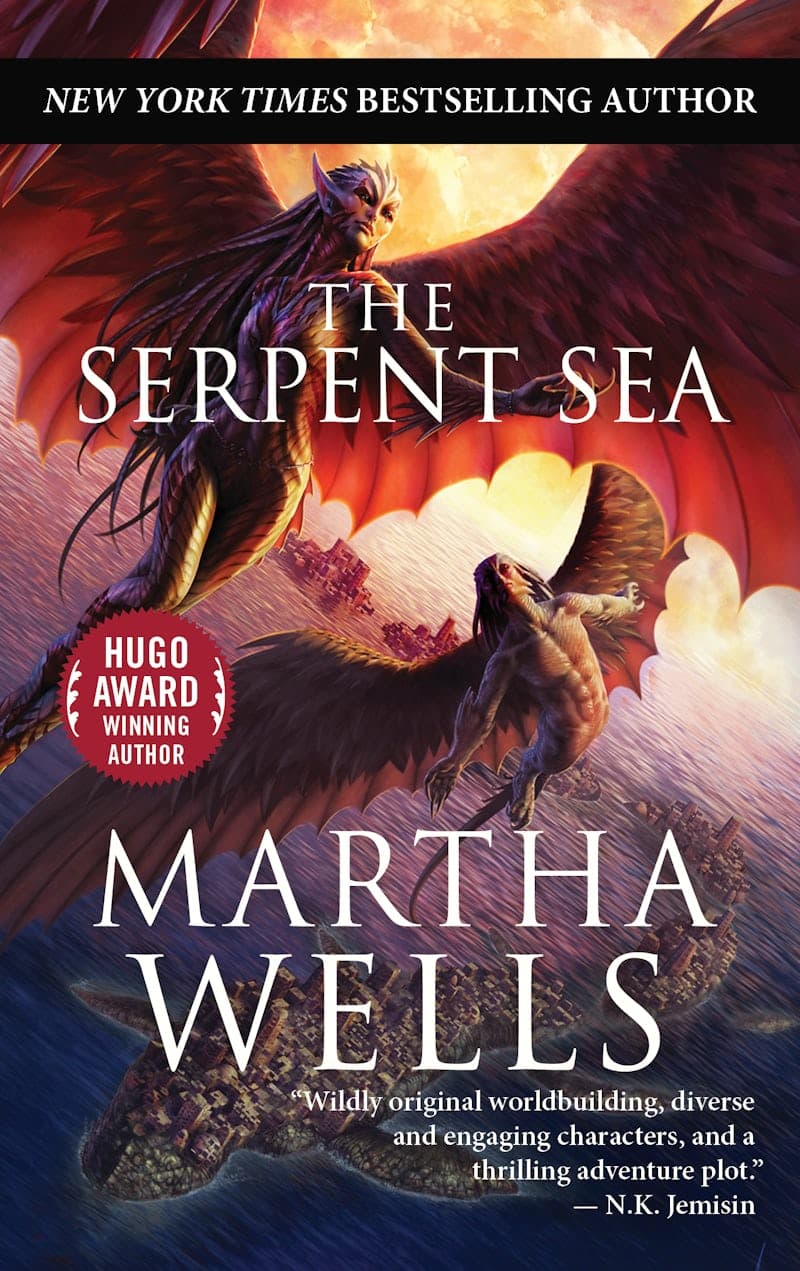
Should you read The Serpent Sea?
What works
The ancestral mountain-tree immediately complicates the promise of home by making survival depend on something already taken. Every new port and species along the Serpent Sea suggests a world continuing beyond the party's route, while Moon's developing role as consort creates credible social tension.
What may not work for you
The search includes detours whose visual invention exceeds their contribution to the heartstone plot. Because the novel must move the court and establish a new home, some disagreements are deferred rather than resolved, and the quest can feel like a bridge between larger changes.
What may test your patience
After the striking arrival at the mountain-tree, the investigation becomes a travel narrative with negotiations and false starts. Readers most invested in Indigo Cloud's internal relationships may find the time away from the court long.
Does the ending reward the effort?
Yes. The recovery effort produces a clear consequence for the court, and Moon's choices show real growth without pretending his fear of rejection has vanished.
Reading The Serpent Sea closely
After the upheaval of The Cloud Roads, Indigo Cloud reaches the ancestral mountain-tree that should provide a permanent home. Instead, the tree is failing because its heartstone has been removed. The discovery makes return inseparable from theft: the court has found the place it belongs and may still be unable to live there.
Moon, Jade, Stone, and a small group cross the Serpent Sea to recover the missing stone. The journey opens the Three Worlds further, moving through ports and communities that have their own relationships with flying predators, traders, and outsiders. Wells lets each encounter feel culturally specific without converting the trip into disconnected travel episodes.
Moon's position as Jade's consort remains emotionally unsettled. Other Raksura understand his role through customs he only recently learned, and he cannot easily distinguish welcome from need. The heartstone mission gives him a practical place in the court while also allowing him to avoid asking whether that place will remain once the emergency is over.
The middle can wander. Several obstacles are memorable as settings but only loosely advance the search, and time away from Indigo Cloud delays the internal court tensions established at the opening. The novel is strongest when exploration creates a decision about trust, not when one more hazard simply redirects the route.
Even with that looseness, The Serpent Sea is an excellent second volume. Its landscapes demonstrate that the originality of the first book was not confined to one court, and the resolution changes Indigo Cloud's prospects in a concrete way. Read it for expansion and adventure, then continue to The Siren Depths for the more concentrated reckoning with Moon's past.
Home depends on a stolen heart
The mountain-tree is both habitat and inheritance. Removing its heartstone turns ecological survival into a political question about who can possess the resource that allows a community to return.
The Serpent Sea feels inhabited
Ports and traveling peoples respond to the party according to trade, rumor, and prior experience. The world does not wait for Moon to explain it, which gives the journey a scale beyond the immediate quest.
A new role does not end old fear
Moon can perform the work expected of a consort while still assuming his acceptance is conditional. Wells allows competence and insecurity to coexist rather than using public success as a quick cure.
Three useful comparisons
The Cloud Roads
The Cloud Roads has the stronger introduction because every discovery changes Moon's understanding of himself. The Serpent Sea assumes that foundation and turns outward, visiting stranger societies and testing his new role. Start with book one; choose book two when exploration and a sustained recovery quest appeal more.
Best for: Readers who want nonhuman protagonists, found family earned through conflict, inventive ecological fantasy, aerial action, a slow-building romance, and a complete adventure that opens into a longer series.
The Siren Depths
The Siren Depths returns forcefully to Moon's origins and supplies the trilogy's deepest personal payoff. The Serpent Sea is more outward-facing, with a stolen resource and a broad journey. Read both in order, but expect the second to emphasize world and the third to emphasize identity.
Best for: Readers who completed the first two Raksura novels and want Moon's past addressed, more court politics, difficult questions about birth and chosen family, and the opening trilogy's most satisfying conclusion.
Children of Ruin
Children of Ruin crosses an alien environment where communication and biology create the central danger, using a large time scale and harder scientific frame. The Serpent Sea is warmer and more adventurous. Its strange beings are encountered through trade, hospitality, predation, and the immediate needs of a traveling family.
Best for: Readers who finished Children of Time and want stranger minds, more horror, and a denser communication problem.