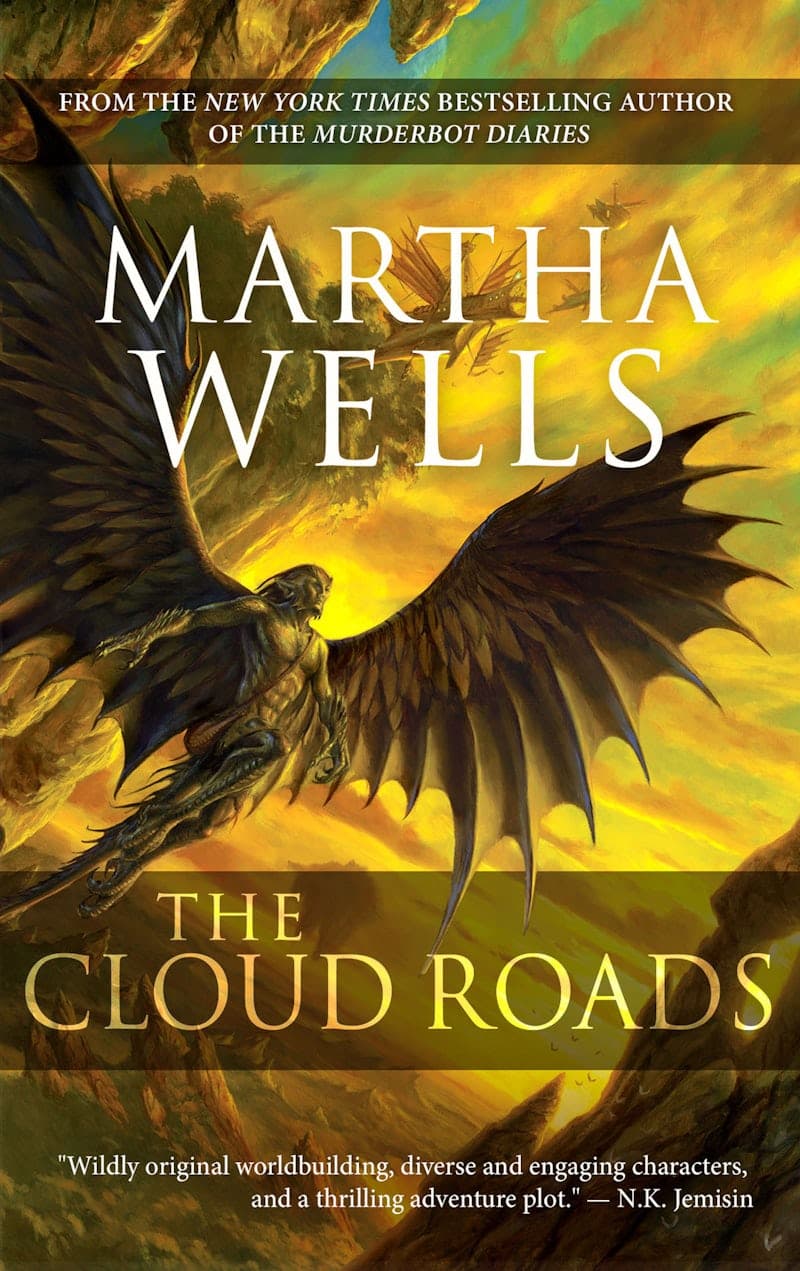
Should you read The Cloud Roads?
What works
Moon is prickly, observant, and shaped by years of hiding rather than by a prophecy. Indigo Cloud offers him community without making acceptance simple. The Raksuran forms, court roles, and living mountain-trees are revealed through his mistakes, so worldbuilding remains tied to vulnerability.
What may not work for you
The Fell are effective predators but initially broad antagonists, and the rescue structure becomes familiar beside the originality of the setting. Court terminology and reproductive roles arrive quickly enough that some readers will need time to stop translating them into human categories.
What may test your patience
Moon's first days at Indigo Cloud require learning queens, consorts, warriors, Arbora, and several kinship expectations while he distrusts nearly everyone. The social map becomes rewarding, but it is the book's steepest adjustment.
Does the ending reward the effort?
Yes. The climax tests whether Moon will act for a community before believing he can remain in it, and the final emotional decision feels provisional in exactly the right way for someone unused to safety.
Reading The Cloud Roads closely
Moon has survived by moving between communities and hiding his ability to transform into a winged shape. He resembles the predatory Fell closely enough that discovery usually produces fear or violence. When Stone recognizes him as a Raksura and offers a place at Indigo Cloud, the possibility of belonging feels less like rescue than a new kind of risk.
Indigo Cloud is a living court with queens, consorts, warriors, Arbora, children, rivalries, and an immediate survival problem. Moon has no vocabulary for the role others believe he should occupy. Wells makes the resulting misunderstandings more than comic exposition. Every mistake exposes how long he has lived without the kinship knowledge everyone around him takes for granted.
The Three Worlds are one of the novel's great pleasures. Settlements hang in impossible landscapes, intelligent peoples vary radically in body and custom, and flight has physical consequences. Wells rarely stops the story to admire invention. A structure matters because the court must defend it; a body shape matters because strangers may misidentify it; an ecological resource matters because a community needs it.
The Fell are less complicated than the Raksura. Their predatory social mimicry is frightening and gives the climax urgency, but they initially represent a broad consuming threat beside Indigo Cloud's detailed internal life. The rescue pattern is also familiar. What keeps it alive is Moon's uncertainty about whether helping this court will finally make him part of it or simply useful again.
The Cloud Roads is a strong entry point for readers who want fantasy without humans at its center. The romance with Jade develops through wariness and social expectation rather than instant certainty. More important, Moon's found-family arc never treats welcome as a cure for abandonment. He has to learn a community, and the community has to make room for the person he became while surviving alone.
Moon is not waiting to be revealed as chosen
His unknown lineage creates questions, but his value comes from practiced survival, attention, and difficult decisions. The story is about entering a social world, not discovering that the world was designed around him.
Raksuran society is biological and political
Different forms and court roles affect labor, authority, reproduction, and vulnerability. Wells presents those structures as lived arrangements with tensions rather than as a list of exotic traits.
Flight changes the prose
Aerial movement depends on wind, weight, fatigue, visibility, and places large bodies can land. Those repeated physical constraints make transformation feel embodied and keep the action from becoming effortless spectacle.
Three useful comparisons
Children of Time
Children of Time gives nonhuman society the larger evolutionary and scientific framework, following cultural change across generations. The Cloud Roads stays close to one displaced adult and makes unfamiliar biology part of courtship, kinship, and home. Choose Tchaikovsky for civilizational scope; Wells for intimate belonging and fantasy adventure.
Best for: Readers who like big evolutionary ideas, nonhuman viewpoints, and long time scales more than a conventional hero's journey.
The Hobbit
The Hobbit follows a reluctant traveler out of a familiar home and uses a clear quest to introduce a large world. Moon begins without any safe home to leave, and his journey is toward community rather than away from it. Wells is more socially complex, more adult, and less episodic.
Best for: Families, younger readers, and adults wanting an accessible classic adventure with humor, danger, and moral weight.
Someone You Can Build a Nest In
Both novels center a nonhuman protagonist whose body and instincts challenge the human assumptions around them. Wiswell leans into horror, romance, and comic discomfort within a largely human society. Wells builds an entire ecology of intelligent peoples and focuses more on court belonging, flight, and communal survival.
Best for: Come for queer monster romance, body horror, disability themes, abusive-family recovery, dark comedy, and a protagonist whose nonhuman nature remains meaningful.