Release details
Scion release date, series status, and formats
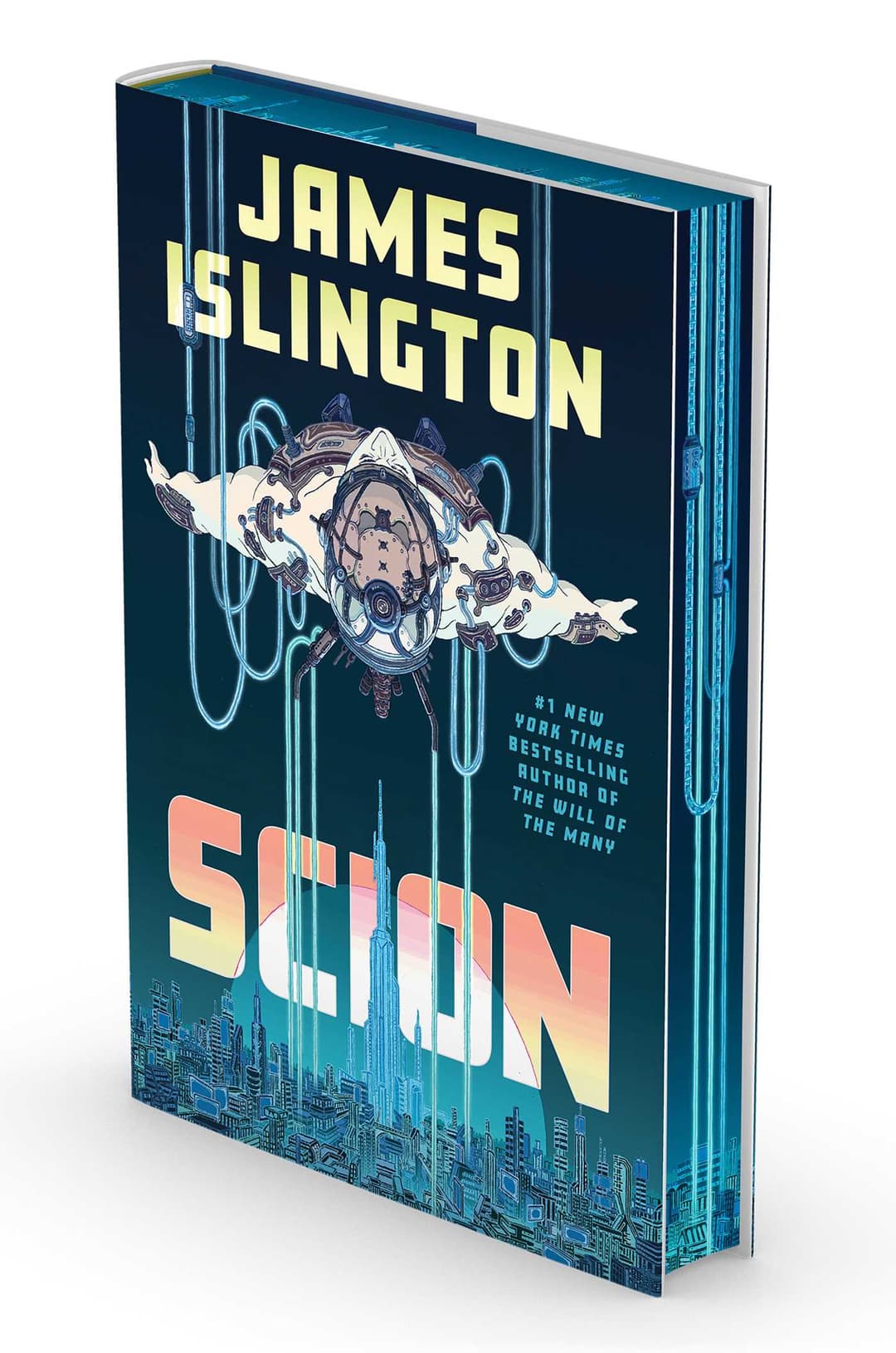
Scion was published on September 1, 2026 by Saga Press. It is Book 1 of James Islington's separate science-fiction series, rather than a Hierarchy installment.
- Release date
- September 1, 2026
- Series position
- Scion, Book 1; listed separately from the Hierarchy series
- Genre
- Cyberpunk science fiction and action thriller
- Length
- 240 pages in the Saga Press hardcover listing
- US formats
- Hardcover and eBook from Simon & Schuster; the author also links to an audiobook edition
- Reading order
- Begin with Scion; The Will of the Many and the Licanius Trilogy are separate starting points
Primary sources: James Islington official website, Simon & Schuster / Saga Press
Should you read Scion?
What works
Azure's surprisingly cheerful voice makes the violence more unsettling, not less. I liked the contrast between his practical complaints and the ugly business he treats as normal. Genetic enhancements, security technology, and purchased longevity matter because they change what his job costs and whom it serves.
What may not work for you
The supporting characters rarely gain Azure's depth, and the city has too little room to develop an atmosphere beyond its immediate dangers. I wanted more of the people living under this corporate order, rather than another reason to move Azure toward the next confrontation.
What may test your patience
The opening throws bios, revs, tokens, and specialized weapons into an action scene before offering much orientation. Their practical uses become clear, but there is an early adjustment to unfamiliar terms while Azure is already fighting for his life.
Does the ending reward the effort?
For me, only partly. The ending is abrupt and deliberately open, leaving the main arc unresolved and making the final scenes feel like the beginning of a larger story. It gives the sequel a strong invitation, but I was less convinced by the payoff of this first volume on its own.
Reading Scion closely
Azure makes a living killing lifers, people wealthy enough to keep extending their lives. His work can be legal; that does not make it morally clean. A genetically enhanced body helps him do the job, and debt helps explain why he keeps doing it. I liked Scion most when those circumstances collide with his remarkably cheerful narration. He is funny company without becoming an innocent man, and a protection assignment puts a different demand on skills usually used to kill.
The life-extension premise gives the inequality a particularly unpleasant edge. Wealth buys more than comfort: it changes how long a person can remain in the world. Corporate interests and biological engineering belong to the same economy, with bodies improved, defended, and put to work. Scion makes these ideas tangible through danger. An enhancement can help Azure move, but it does not make damage irrelevant. That practical relationship between technology and flesh interested me more than a catalogue of futuristic inventions would have.
Azure carries the novel. His black humor, blunt assessments, and bright attitude give the first-person voice an appealing friction with the violence around him. The action moves quickly, and his personality keeps it from becoming a sequence of anonymous fights. I was less convinced by the supporting cast. Other people too often help move the assignment along without acquiring comparable depth, so the book's liveliness depends heavily on enjoying the man at its center.
The 240-page Saga Press hardcover is compact by design, and I think the length is both its advantage and its limit. There is little waiting around while Islington explains the setting. New terminology arrives amid action, with enough practical context to keep moving. That gives the thriller a fierce pace, but the wider world has less room to breathe. I wanted more atmosphere and more ordinary life around the corporate power and the engineered danger.
My largest reservation is the ending. It is abrupt and openly prepares a larger story rather than closing the main arc cleanly. I can see the appeal of that invitation to a sequel, but it reduces the satisfaction of Scion as a first book in its own right. For me, the four-star case rests on Azure's voice and the sheer energy of his dangerous work. Choose it for those pleasures, with the expectation that the answers and fuller development will need another volume.
Is Scion connected to The Will of the Many?
Scion begins a separate series from Hierarchy. The Will of the Many is Hierarchy Book 1; Scion is its own science-fiction Book 1, with Azure as its protagonist. You can start here without reading either Hierarchy or the Licanius Trilogy.
The change is also one of scale and form: Scion is a compact cyberpunk thriller rather than an academy-centered political fantasy. The James Islington author guide sets out the separate starting points and the books covered here.
Is Scion's worldbuilding difficult to follow?
The terminology is concentrated at the beginning. Revs are Azure's bodily enhancements, while bios are engineered security creatures; both enter as immediate practical problems. I found the action easier to follow than the initial vocabulary might suggest. The bigger limitation is space: the book shows what matters to Azure's dangerous work more fully than it shows the society around him.
Three useful comparisons
Chasm City
Chasm City shares Scion's altered bodies, hired violence, and extreme inequality, but Reynolds gives the city and the identity mystery much more space. Choose it for denser, darker noir; Scion is the faster, more compact action story.
Best for: Choose it for SF noir with body modification, ruined cities, violence, and an unreliable identity; the story can stand alone.
Mickey7
Mickey7 also gives mortality a workplace price and a narrator who jokes around an ugly employment arrangement. Its colony and replacement bodies lead toward personhood and bureaucratic comedy, while Scion follows an engineered killer through immediate physical danger.
Best for: Science-fiction readers wanting cloning, hostile-planet survival, corporate exploitation, existential questions, and dark humor in a compact standalone story.
Red Rising
Red Rising ties bodily engineering to class inequality and violent first-person tactics, as Scion does. Darrow's academy infiltration points toward revolution; Azure begins as a professional working inside his society's legal killing economy.
Best for: Pick it for violent caste rebellion, hidden identity, academy warfare, fast tactics, and a Roman-inspired space society.