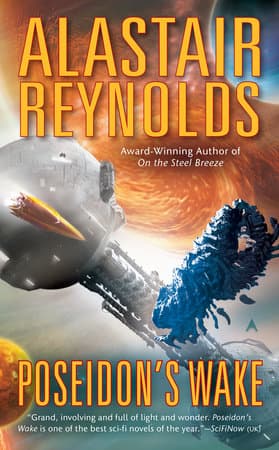
Should you read Poseidon's Wake?
What works
The signal, Crucible, uplifted elephants, Watchkeepers, and distant Akinya descendants bring earlier choices into one question about coexistence.
What may not work for you
New protagonists dilute attachment, recaps and history are dense, and convergence is slower than the final contact warrants.
What may test your patience
Separate societies and generations must be reestablished before the signal turns them toward a shared destination.
Does the ending reward the effort?
Mostly. The contact resolution is humane and thematically consistent, but some family and political threads receive less emotional closure.
Reading Poseidon's Wake closely
Poseidon's Wake begins with a message from Crucible, seventy light-years away: Send Ndege. Ndege Akinya remains under house arrest after a catastrophe, so her biologist daughter Goma joins an expedition aboard Travertine to learn who sent the message and why her family is being summoned.
Another strand follows Kanu, a diplomat drawn into contact with intelligent elephants and machine mysteries closer to home. Across the novel, humans, Tantors, artificial minds, and the ancient Watchkeepers approach Crucible with different histories and definitions of who deserves to speak for a species.
The conclusion to Poseidon's Children is expansive, optimistic, and interested in communication more than conquest. Its many characters and inherited events make it unsuitable as an entry point, but the payoff is a first-contact story where family guilt, uplifted intelligence, and the right to choose a future matter as much as interstellar engineering.
Send Ndege and the weight of family history
The brief message turns one disgraced person into the apparent key to an alien-scale event. Goma's decision to travel tests whether children can seek truth about a parent's actions without accepting either inherited guilt or the family's preferred account.
Humans, Tantors, machines, and Watchkeepers
The novel refuses to make intelligence a single ladder with humans at the top. Elephant cognition, machine autonomy, and alien structures create overlapping claims to personhood, representation, and contact, often exposing how quickly curiosity becomes control.
Finale, complexity, and tone
This is the most interstellar and idea-dense volume of the trilogy. It brings forward consequences from both earlier books while maintaining a more hopeful view of cooperation than Revelation Space, even when communication creates danger and irreversible misunderstanding.
Three useful comparisons
On the Steel Breeze
On the Steel Breeze is the required and more urgent middle volume.
Best for: Blue Remembered Earth readers wanting generation ships, artificial intelligence, identity copies, and higher-stakes space travel.
As an Amazon Associate, I earn from qualifying purchases.
Children of Time
Children of Time handles uplift and cross-species understanding with a cleaner standalone arc.
Best for: Readers who like big evolutionary ideas, nonhuman viewpoints, and long time scales more than a conventional hero's journey.
As an Amazon Associate, I earn from qualifying purchases.
House of Suns
House of Suns delivers comparable scale in a tighter, more emotionally focused standalone.
Best for: Choose it for an accessible standalone epic with deep time, clones, machine people, romance, pursuit, and galactic mystery.
As an Amazon Associate, I earn from qualifying purchases.
Make the next decision