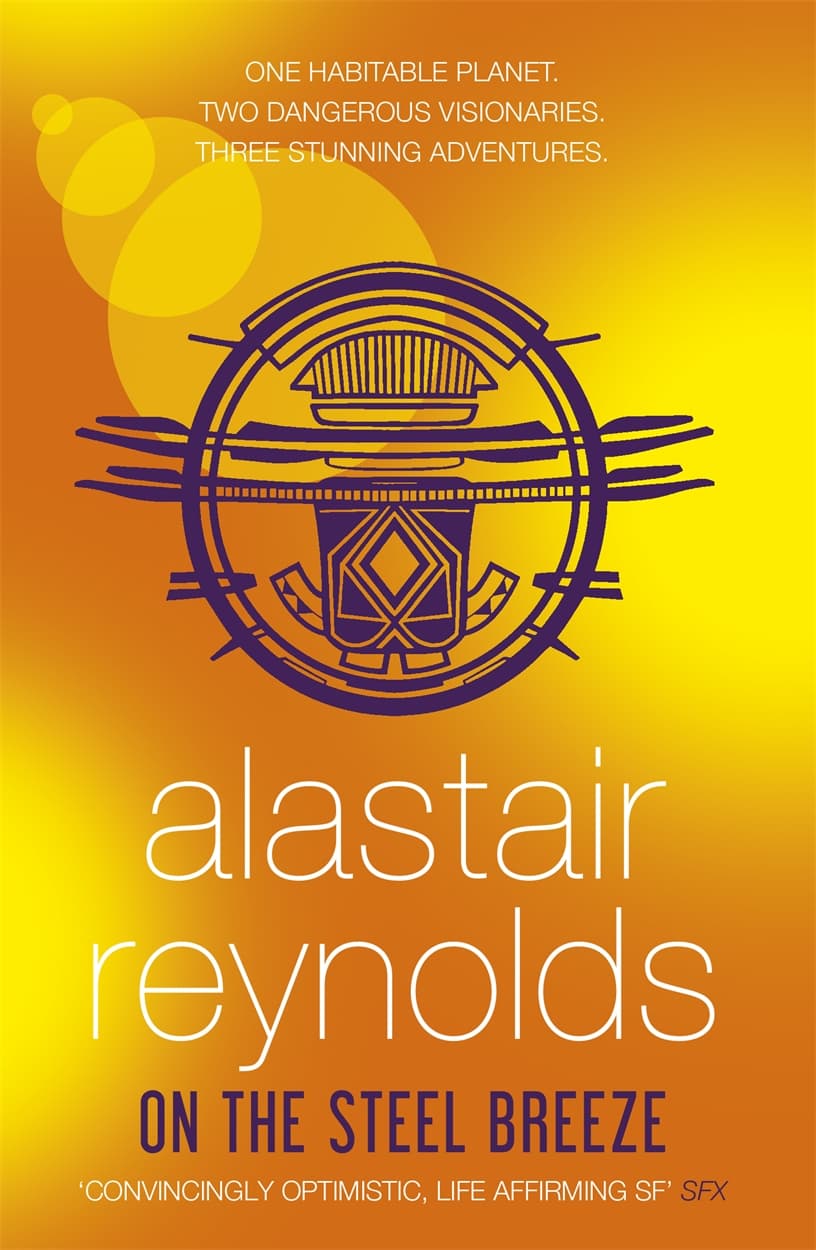
Should you read On the Steel Breeze?
What works
Chiku's divided continuations, the holoships, Watchkeepers, and Crucible turn identity and governance into practical survival questions.
What may not work for you
The family connection is emotionally diffuse, technological factions are dense, and the novel assumes patience with book-one history.
What may test your patience
Multiple versions of Chiku and separated locations require orientation before the holoship danger becomes one central line.
Does the ending reward the effort?
Yes as a middle volume. Major choices alter the mission and machine relationship while leaving the destination's full meaning for the finale.
Reading On the Steel Breeze closely
On the Steel Breeze moves the Poseidon's Children sequence into interstellar space. Chiku Akinya creates three versions of herself, allowing one life to divide between Earth, Eunice Akinya's unfinished trail, and the holoships carrying millions of people toward the habitable planet Crucible.
Chiku Green travels aboard Zanzibar as political tensions grow within the fleet and the destination's alien Mandala becomes more troubling. Chiku Yellow remains connected to an Earth increasingly shaped by machine intelligence, while Chiku Red pursues answers that may change what the travelers believe about their mission.
The novel combines generation-ship politics, identity copying, artificial intelligence, elephants, and first contact on a scale much larger than Blue Remembered Earth. Its three versions of Chiku require attention, but they give the book a distinctive way to explore how one person changes when different choices and centuries separate her lives.
Three Chikus and one divided identity
Red, Green, and Yellow begin with shared memories but immediately become separate people. Their divergence makes copying more than a technical convenience: each must decide whether obligation to an original plan still binds a self who has lived through different consequences.
Holoships, politics, and artificial intelligence
The voyage to Crucible is a social project as much as an engineering one. Leadership, resource limits, surveillance, and machine advice influence millions of sleeping and waking passengers, making trust in the fleet's systems a political question with generational stakes.
Difficulty and series order
The rotating Chiku identities, time gaps, and competing intelligences make this denser than the first book. It should be read after Blue Remembered Earth because Eunice's legacy, the Akinya family, and the origins of the Crucible mission drive its conflicts.
Three useful comparisons
Blue Remembered Earth
Blue Remembered Earth is slower, warmer, and the required family foundation.
Best for: Best for optimistic future Africa, family mystery, elephants, solar-system infrastructure, and slow generational science fiction.
As an Amazon Associate, I earn from qualifying purchases.
Poseidon's Wake
Poseidon's Wake completes the trilogy across generations and contact with the alien machines.
Best for: Readers who completed the first two Poseidon's Children novels and want large-scale, ultimately hopeful contact.
As an Amazon Associate, I earn from qualifying purchases.
Pushing Ice
Pushing Ice is a stronger standalone generation-voyage story with harsher crew politics.
Best for: The draw is standalone hard SF with generation survival, first contact, cosmic scale, and abrasive human politics.
As an Amazon Associate, I earn from qualifying purchases.