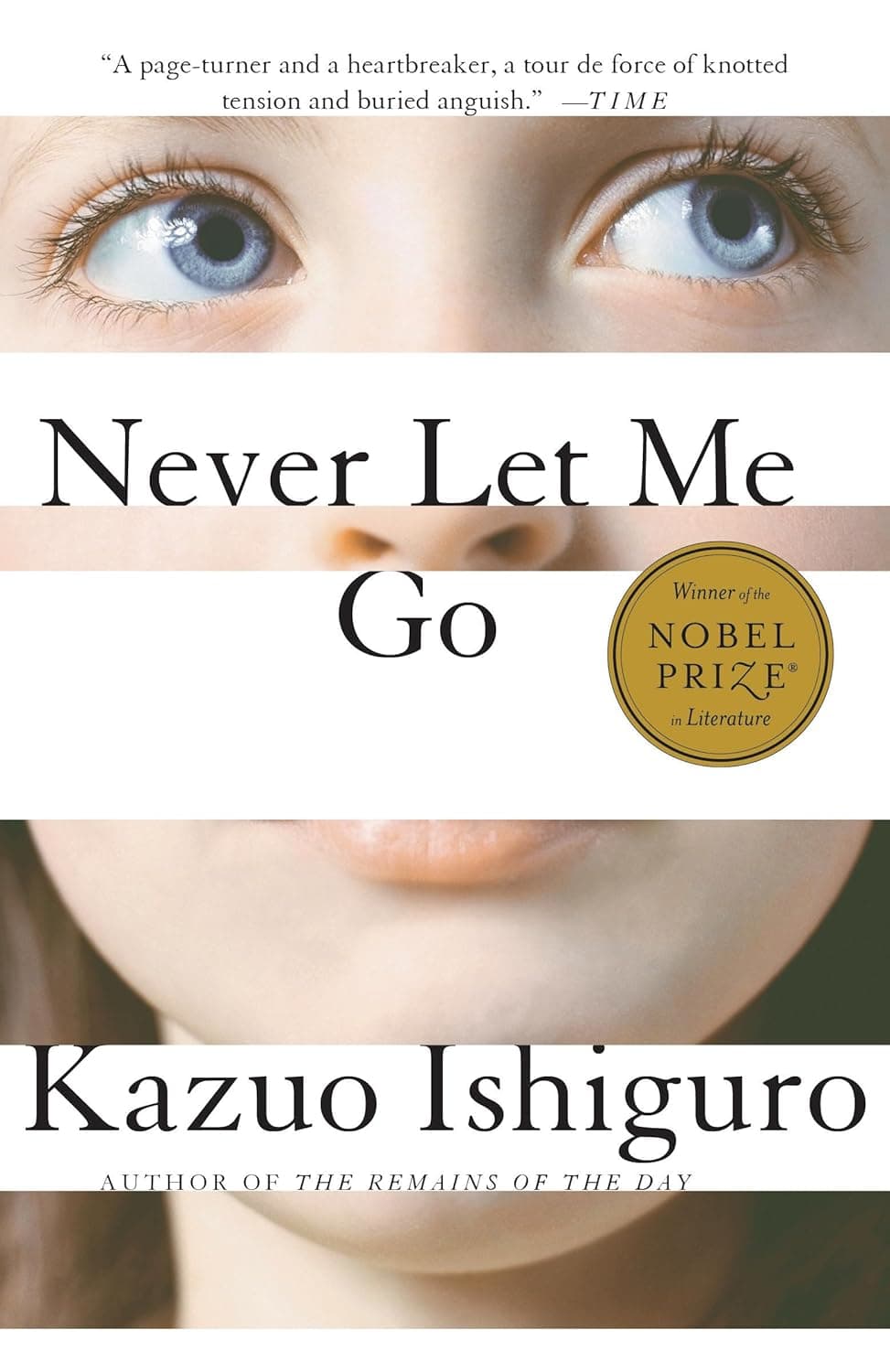
Should you read Never Let Me Go?
What works
The friendships among Kathy, Ruth, and Tommy remain petty, loving, jealous, and unfinished. Their ordinary emotional mistakes prevent the novel's ethical problem from becoming a sterile thought experiment.
What may not work for you
Kathy's circling memories can feel overly controlled, and readers wanting active resistance may find the characters' acceptance frustrating even when it is central to the design.
What may test your patience
The Hailsham chapters linger on exchanges, rumors, art, and small childhood disputes before the institution's purpose becomes explicit. The delayed clarity is essential, but it asks for trust in apparently minor memories.
Does the ending reward the effort?
Completely. The final scene gathers loss, fantasy, and Kathy's habit of controlled recollection into an image that is restrained enough to avoid emotional manipulation.
Reading Never Let Me Go closely
Kathy H looks back on Hailsham, a sheltered English boarding school where art projects, health checks, and vague warnings define daily life. Ishiguro reveals the speculative premise slowly, so the book first feels like a memory-driven coming-of-age story before the limits on Kathy, Ruth, and Tommy become clear.
Kathy circles back to half-finished arguments and small humiliations, correcting the order as though accuracy might also make the past manageable. Ruth remains both the friend she loved and the person who hurt her; Tommy remains the future they kept postponing. The hesitations show Kathy editing pain into a story she can calmly tell.
There is almost no scientific explanation. Teachers hint around Hailsham's purpose, guardians disagree about what the students should know, and rumors substitute for any real view of the outside world. The horror comes from how politely everyone discusses a system that treats certain bodies as supplies.
Kathy, Ruth, and Tommy waste time through pettiness, jealousy, kindness, and delay just as ordinary friends do. That is why the final chapters hurt: the system limits their lives, but they also lose chances without knowing how few they have. The subdued ending leaves their acceptance looking tragic, learned, and painfully understandable.
The prose is easy to follow, but the book is sad, reflective, and slow. Sex, illness, care work, and loss are described without melodrama. Do not choose it for rebellion or a scientific puzzle; choose it for Kathy's quiet attempt to understand the life she was allowed.
Three useful comparisons
Brave New World
Brave New World explains its engineered society through satire and debate. Never Let Me Go stays with three lives inside one quiet corner of the system and is far more emotionally intimate.
Best for: Readers who prefer idea-driven dystopia and social satire to intimate characterization or sustained suspense.
The Handmaid's Tale
The Handmaid's Tale features explicit authoritarian ritual and a narrator preserving forbidden memory. Ishiguro's characters face softer conditioning and less visible force, which makes their compliance more unsettling.
Best for: Readers interested in reproductive control, memory, religious authoritarianism, and narrators whose uncertainty is part of their resistance.
Frankenstein
Frankenstein asks what a creator owes the life it brings into being through Gothic confrontation. Never Let Me Go turns the same question into institutional routine and withheld futures.
Best for: Readers interested in responsibility, isolation, unreliable self-justification, and Gothic philosophy more than conventional horror.