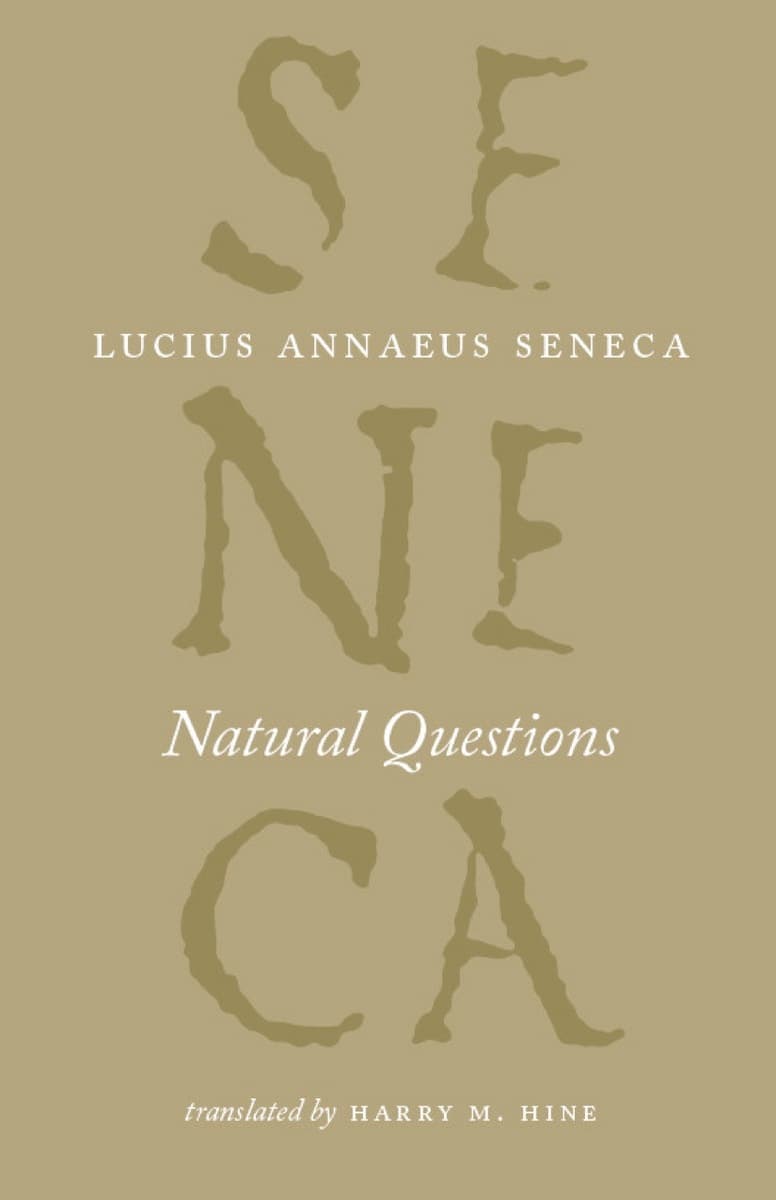
Should you read Natural Questions?
What works
Harry M. Hine gives distinct movement to Seneca's changes of register, from a careful inventory of possible causes to a vivid earthquake or storm and then an attack on luxury. The notes explain ancient theories without making the translation feel like a classroom paraphrase.
What may not work for you
Many explanations are necessarily obsolete, and Seneca sometimes abandons a promising physical question for a familiar condemnation of greed or excess. The reordered books improve the progression, but repeated taxonomies of winds, waters, and lightning can still feel more exhaustive than illuminating.
What may test your patience
The longest test comes when competing ancient explanations accumulate without enough surviving evidence to decide among them. Readers looking only for quotable Stoic advice may also find the causal catalogues unexpectedly technical.
Does the ending reward the effort?
Yes, as an intellectual progression rather than a narrative conclusion. The later investigation of thunder and lightning gathers questions about divine causation, fear, and natural law into the book's clearest account of why physics matters to ethics.
Reading Natural Questions closely
Natural Questions is Seneca's attempt to understand the physical world without separating that effort from the formation of character. Rivers, the Nile, rain, snow, winds, earthquakes, comets, atmospheric fires, thunder, and lightning each become problems of causation. They also become tests of whether human beings can confront scale and uncertainty without retreating into superstition or trivial appetite.
Harry M. Hine presents the books in a reconstructed order that begins with terrestrial waters and moves upward through weather, seismic events, and the sky before concluding with lightning and thunder. The decision matters. Seneca's field of vision appears to widen, and the reader can see his recurring method: gather reports, compare earlier authorities, reject explanations that fail, and leave some questions honestly unresolved.
This is ancient science, not a source of current scientific knowledge. Seneca can be perceptive about observation and physical continuity while accepting cosmological assumptions that modern evidence has overturned. The value lies in watching causal reasoning before modern instruments and disciplines. His discussion of earthquakes is particularly strong because natural terror forces him to ask what explanation can do when no place is completely safe.
The moral digressions are both the book's distinction and its recurring frustration. A dying fish displayed for luxury or wealth extracted from the earth can produce memorable satire, but Seneca sometimes leaves the natural phenomenon just as inquiry becomes most interesting. He regards curiosity without ethical improvement as incomplete, while a modern reader may reasonably want the curiosity to receive more uninterrupted space.
Hine's introduction, analytical contents, notes, and references make this the edition to choose for serious reading in English. It is not the easiest first Seneca because the catalogues and disputed mechanisms require patience. For readers interested in how Stoicism understood nature, however, it reveals a philosopher larger than the familiar writer of advice about time and adversity.
Ancient physics as a moral exercise
Seneca does not investigate nature simply to accumulate facts. A reliable account of causes should reduce fear, correct superstition, and place individual ambition inside a cosmos that does not revolve around human status.
Hine's sequence gives the work a shape
The reconstructed order moves from waters and weather toward increasingly large or frightening phenomena. That ascent makes recurring questions about causation, providence, and human scale easier to see across separate books.
Scientific errors remain historically useful
Incorrect explanations should not be rescued as hidden modern discoveries. Their interest comes from the evidence Seneca had, the alternatives he considered, and the standards by which an ancient writer tried to distinguish a cause from a story.
Three useful comparisons
Cosmos
Cosmos explains a modern scientific picture through narrative, biography, and visual scale, and is far more reliable as science. Natural Questions shows an earlier thinker working without that evidence while asking a related moral question: whether understanding nature can loosen the grip of fear, vanity, and local human importance.
Best for: Curious general readers and older teens wanting a humane, accessible route into astronomy, scientific history, and cosmic perspective.
The Varieties of Scientific Experience
Sagan separates testable explanation from religious assertion while remaining receptive to awe. Seneca assumes a providential cosmos and treats physical law as part of theology. Read Sagan for modern evidential standards; read Seneca to see science, divinity, and ethics operating inside one ancient philosophical project.
Best for: Best for readers interested in science, religion, natural theology, and intellectually respectful disagreement who are comfortable with a lecture sequence. Skip it if you want Cosmos's broad narrative sweep, a practical skepticism handbook, or a continuous story rather than recurring arguments and open questions.
Letters on Ethics
Letters on Ethics begins with recognizable incidents such as noisy baths, illness, friendship, and wasted time before widening into Stoic doctrine. Natural Questions begins with rivers, weather, and the heavens. Choose the Letters for daily practice and personal voice, this volume for physics and cosmic perspective.
Best for: Readers who want the complete Letters rather than a selection, a sustained introduction to Stoic ethics, Roman daily life, friendship, mortality, education, literary criticism, and enough scholarly support to follow the later technical arguments.