Should you read Loathe to Love You?
What works
A shared house, a stalled elevator, and an Arctic rescue put immediate pressure on three professional conflicts. The friendship among Mara, Sadie, and Hannah also links stories that otherwise stand alone.
What may not work for you
The heroines share the same anxious voice, the men have similar bodies and temperaments, and missing information keeps two conflicts alive after an honest conversation could have ended them.
What may test your patience
Reading all three consecutively highlights repeated voice, body type, and enemies-to-lovers beats more than reading them separately.
Does the ending reward the effort?
Each couple gets a clear ending. By the third one, the route from hostility to attraction is familiar enough that the friendship among the women provides more surprise than the romance.
Reading Loathe to Love You closely
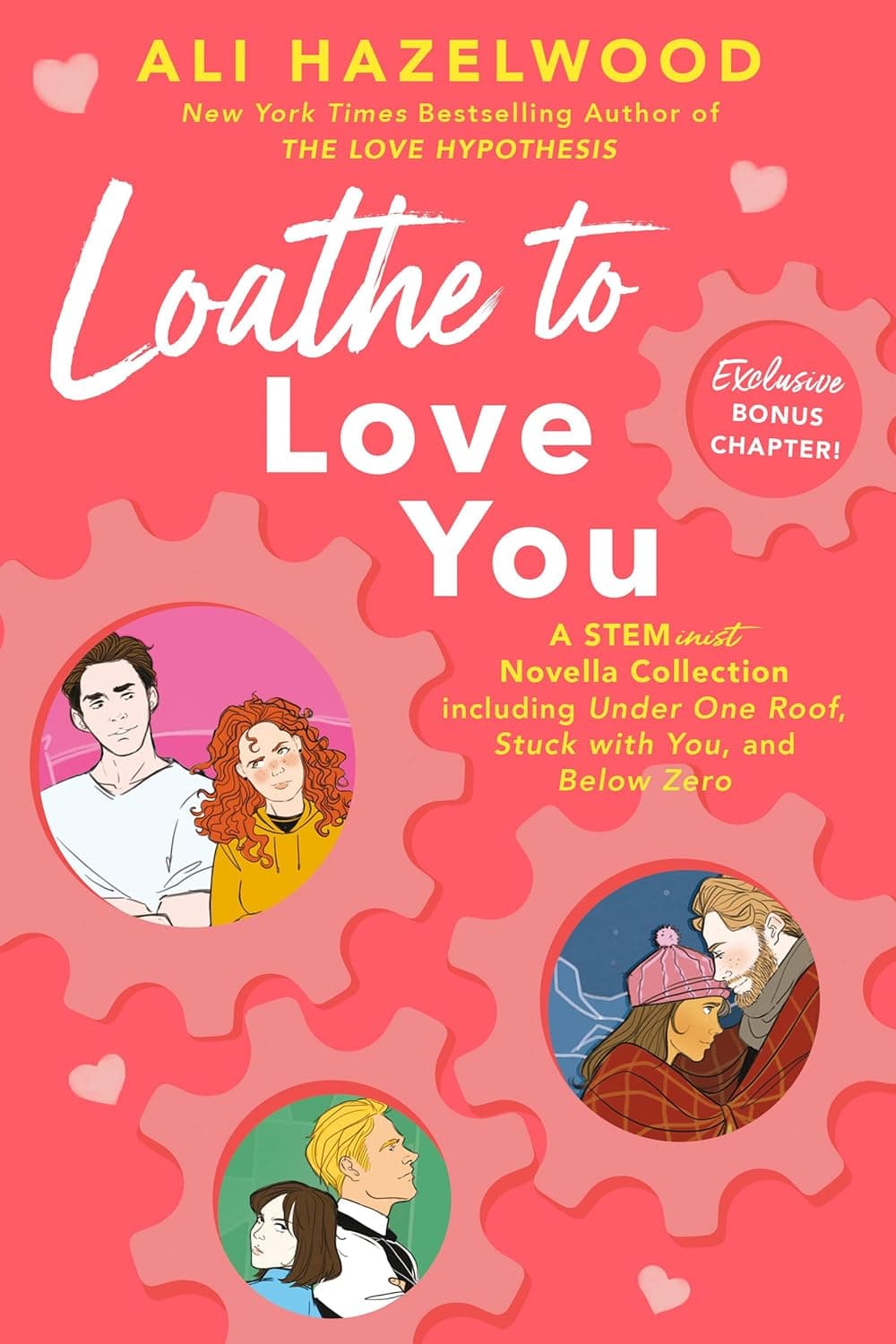
Loathe to Love You collects three linked novellas rather than building one romance across a full novel. Mara, Sadie, and Hannah are friends working in scientific and engineering fields, and each story places one woman in close quarters with a man she believes she has good reason to resist. The friendship interludes create continuity, but every couple reaches its own conclusion before the next takes over.
Under One Roof has the strongest domestic setup. Environmental engineer Mara inherits half a house and discovers that the other half belongs to Liam, a lawyer whose work for the oil industry makes him an ideological as well as territorial opponent. Their arguments use kitchens, thermostats, and shared rooms to make attraction inconvenient. The professional conflict is promising, although the novella resolves the moral distance between their jobs more easily than the premise deserves.
Stuck with You compresses a damaged relationship into an elevator. Sadie and Erik have already crossed from attraction into disappointment, so confinement forces the story to reconstruct what went wrong. The structure gives the banter immediate pressure and makes this the quickest entry in the collection. It also exposes Hazelwood's dependence on missing information: a short honest conversation could remove much of the hostility, and the limited length leaves little room for trust to rebuild gradually.
Below Zero supplies the clearest external danger. NASA aerospace engineer Hannah is injured and stranded at a remote Arctic research station, and Ian, her longtime rival, is the person willing to reach her. Cold, isolation, and rescue give their conflict a shape beyond verbal sparring. The setting makes the hero's actions persuasive, though the movement from antagonism to intimacy still relies on Hannah having misread him for longer than his behavior supports.
Taken separately, the novellas are fast and cheerful comfort reads. Taken together, their repeated design becomes impossible to miss: anxious petite scientists, exceptionally large reserved men, professional rivalry, and misunderstandings that preserve the enemies-to-lovers label. The collection works best for readers who enjoy those Hazelwood signatures and want three compact variations. Anyone seeking three genuinely different romantic dynamics will probably find the friendship more varied than the couples.
Three useful comparisons
Love on the Brain
Love on the Brain gives one couple and workplace mystery more room, though with similar archetypes.
Best for: Adult romance readers wanting enemies-to-lovers energy, neuroscience, NASA, workplace sexism, banter, and explicit chemistry.
Check & Mate
Check & Mate offers a sweeter YA register and a clearer competition framework.
Best for: YA romance readers wanting chess, gifted rivals, family pressure, banter, and low-spice emotional payoff.
People We Meet on Vacation
People We Meet on Vacation develops one relationship across years with greater emotional history and less genre compression.
Best for: Adult romance readers wanting years-long friendship, opposites, travel, banter, longing, and moderate emotional angst.