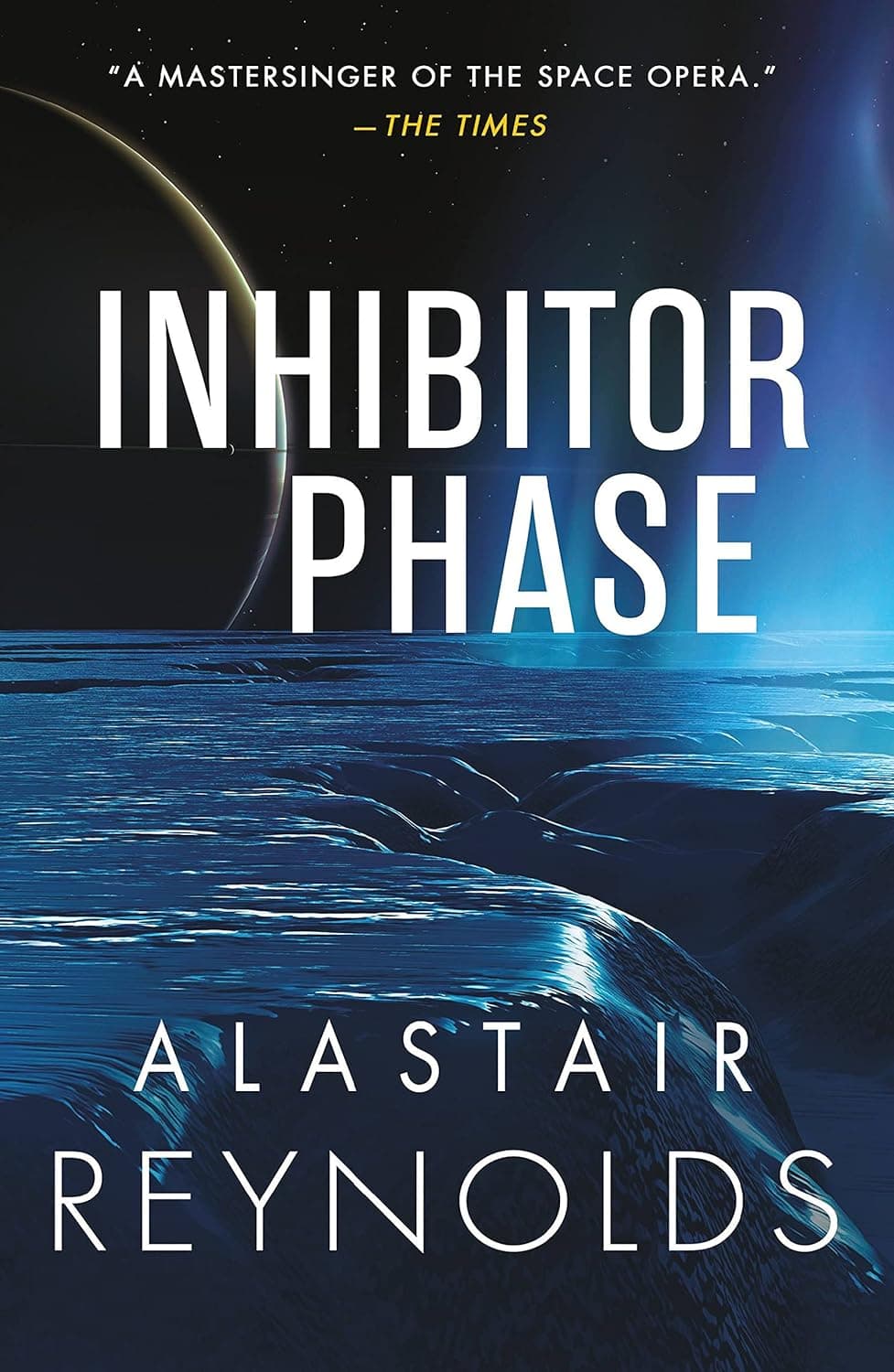
Should you read Inhibitor Phase?
What works
Miguel's refuge, secret identity, altered companions, and weapon search make extinction pressure immediate after the older trilogy's oblique closure.
What may not work for you
Continuity is dense, identity revelations stack up, and exposition sometimes arrives as characters unpack centuries of prior consequence.
What may test your patience
The refuge and recruitment establish several hidden histories before the journey's objective becomes fully legible.
Does the ending reward the effort?
Yes. The mission offers a more direct strategic and emotional response to the Inhibitors while preserving the universe's severe cost.
Planning to read the wider setting first? Follow the Revelation Space reading order before choosing your edition.
Reading Inhibitor Phase closely
Inhibitor Phase returns to the core Revelation Space conflict after machine predators have devastated humanity. Miguel de Ruyter protects a hidden community on Michaelmas by treating secrecy as survival. When a ship approaches, a visitor named Glass pushes him toward a mission whose possible reward is as enormous as its likelihood of failure.
The journey reconnects consequences from Revelation Space, Redemption Ark, and Absolution Gap. Reynolds keeps the objective clear and grounds the cosmic danger in a small group with incompatible motives. Miguel's account is deliberately guarded, so identity and memory become part of the tension.
This is not the best starting point for the universe. Its emotional force comes from recognizing how far civilization has fallen and what earlier characters sacrificed. For returning readers, it offers an intimate route through relativistic travel, transformed bodies, ancient weapons, and choices whose effects can outlive cultures. The tone is severe but not without hope.
After the Inhibitors arrive
Michaelmas survives by minimizing signals and ambition, turning leadership into a calculation about acceptable risk.
A guarded narrator
Miguel's missing history suits a world where names attract danger, while Glass demands trust before certainty.
Reading order matters
The novel uses the original sequence's losses, factions, and technology as emotional foundations.
Three useful comparisons
Redemption Ark
Redemption Ark supplies the most important strategic background and a stronger ensemble pursuit.
Best for: Revelation Space readers ready for faster space opera, factional strategy, evacuation, and ethically dangerous technology.
As an Amazon Associate, I earn from qualifying purchases.
Absolution Gap
Absolution Gap precedes it chronologically but offers more religion and less satisfying war closure.
Best for: Committed trilogy readers comfortable with religious worldbuilding, delayed convergence, and oblique rather than military closure.
As an Amazon Associate, I earn from qualifying purchases.
Revelation Space
Revelation Space is the necessary entry for the threat, factions, and tone.
Best for: Patient readers wanting hard science fiction, archaeology, deep time, morally difficult characters, and cosmic danger.
As an Amazon Associate, I earn from qualifying purchases.
Make the next decision