
Author profile
Jasmin Kirkbride: books, review, and bibliography
In The Forest on the Edge of Time, Jasmin Kirkbride makes memory unreliable enough to damage promises, loyalties, and a person's sense of what has already happened.
Biography and criticism
When memory no longer keeps events in order
The forest bends time, but the real problem is personal: two people may not remember the same promise as part of the same past.
A forest where time cannot be trusted
Jasmin Kirkbride's The Forest on the Edge of Time begins with a place that cannot be crossed as ordinary distance. Time shifts inside the forest, so a traveler may keep the feeling left by an event without knowing where that event belongs.
That uncertainty reaches beyond the mechanics of the setting. A promise may be sincere for both people and still be remembered in a different order. The characters have to decide what trust means when chronology can no longer serve as proof.
The forest is clearest when one detail goes wrong
Kirkbride's prose balances sensory setting with speculative disorientation. The strongest passages do not explain the mechanism immediately; they let a practical detail fail, forcing both character and reader to revise the world. That restraint creates unease without relying on constant danger.
This is Kirkbride's clear starting point. The novel works best when one changed path, misplaced memory, or impossible sequence threatens a relationship the reader already understands.
What the novel reveals about Kirkbride's craft
The Forest on the Edge of Time does not use temporal instability merely to produce a late solution. Its most effective scenes make chronology alter ordinary judgment. A promise may have been made, but the person remembering it cannot be certain that both participants experienced the promise in the same order. A familiar path may lead to a place whose emotional significance belongs to a future the traveler has not lived. This turns time from a puzzle on a diagram into pressure on trust.
Kirkbride is particularly attentive to the way a landscape can appear constant while human orientation fails. Trees, clearings, weather, and boundaries give the reader something tangible, which means a small inconsistency carries more weight than a page of abstract explanation. The forest is readable enough to invite confidence and strange enough to punish it. That balance keeps the novel from becoming either a conventional wilderness story or an opaque sequence of temporal tricks.
The characterization also depends on incomplete continuity. People usually explain themselves through a stable sequence of cause and effect: this happened, therefore I became this person. Kirkbride removes that stability. A character may possess the feeling left by an event without secure access to the event itself. The resulting uncertainty is psychological rather than merely cosmological. Identity becomes an act of arrangement performed with records that may not stay in order.
There are moments when withholding works less well. Mystery can become vagueness if the reader lacks enough fixed information to measure a change, and an atmospheric passage cannot indefinitely substitute for a developing relationship. The strongest parts provide a concrete expectation before disturbing it. They show that Kirkbride's promise as a novelist lies not simply in writing about time, but in understanding that the reader needs a reliable emotional fact before unreality can matter.
Reading uncertainty at sentence level
Kirkbride is most effective before the novel explains its larger rules. A sentence begins with an ordinary action, then adds one detail that cannot belong where it appears. The first reaction is to reread the line, not blame the world. Her characters face the same uncertainty: is the inconsistency evidence, exhaustion, manipulation, or a change ordinary tense cannot describe?
The Forest on the Edge of Time gains emotional force when its abstractions remain attached to responsibility. If cause and consequence no longer arrive in a dependable order, a character cannot rely on intention as a complete defense. Someone may hurt another before understanding the choice that led there, or remember intimacy the other person has not yet experienced. Kirkbride uses those asymmetries to test consent and loyalty rather than merely displaying a clever chronology. The novel occasionally withholds one layer too many, but its best passages know exactly what must stay clear: the reader needs to understand what a person stands to lose even when the path toward that loss has become strange.
One reviewed novel is too little evidence for a fixed account of Kirkbride's career. This book shows that she will let atmosphere delay certainty, but also that the emotional promise must remain clear enough for the time puzzle to matter. A later book will reveal whether forests and fractured chronology are recurring interests or simply the right tools for this story.
For now, the defensible claim is specific: Kirkbride can make landscape, chronology, and trust work on the same problem. Anything broader would turn a promising debut into a manufactured author brand.
Where to begin
The Jasmin Kirkbride book reviewed here
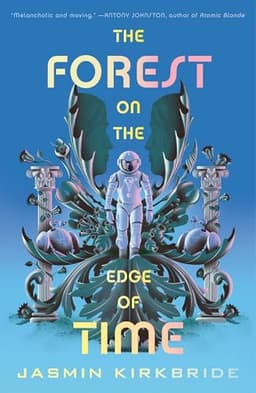
The Forest on the Edge of Time
4.2 / 5The Forest on the Edge of Time finds its drama in what one generation leaves for the next. The family story is firmer than the time-travel rules, but it makes the climate stakes feel personal.
Bibliography
Books by Jasmin Kirkbride
Reviews and book guides open on Book Review Guide. The full list comes from the linked bibliography source.
Reviewed
The Forest on the Edge of Time
Not reviewed yet
Sand
Not reviewed yet
Stress Less

Not reviewed yet
Believe in Yourself
Not reviewed yet
Don't Panic

Not reviewed yet
Boost
Bibliographic source: Open Library.
Books on this site
Jasmin Kirkbride reviews and guides
20264.2 / 5
The Forest on the Edge of Time
A Novel
As an Amazon Associate, I earn from qualifying purchases.
Keep exploring