
Author profile
Gautam Bhatia: books, review, and bibliography
Gautam Bhatia writes speculative fiction beside a career in constitutional law, bringing legal attention to language, authority, dissent, and the machinery that makes an unequal order appear inevitable.
View 1 reviewed bookBiography and criticism
How law and language shape imagined states
Bhatia's fiction does not paste legal debates onto invented worlds. It asks how institutions enter everyday speech and how resistance must operate when power controls the available categories.
A constitutional scholar turns to invented orders
Gautam Bhatia is an Indian lawyer, scholar, and writer known for work on constitutional law and civil liberties as well as speculative fiction. The Wall and The Horizon imagine a city enclosed by a vast barrier and structured by rules that make curiosity politically dangerous. His legal training shows in the rules, official language, and small procedures that turn a strange prohibition into common sense.
Bhatia's governments do not only punish people who ask forbidden questions. They teach citizens that a serious person would never ask the question in the first place. The wall divides the city, but it also narrows what people can imagine about the world beyond it.
The pressure of The Sentence
The Sentence continues Bhatia's interest in language as an instrument of governance. The title itself suggests both grammar and punishment, a duality central to his work. He writes idea-rich speculative fiction in which institutions have procedures, factions, and material consequences rather than existing as allegorical villains.
The prose can be dense because argument is part of the drama. Readers willing to track terms and political structures receive a world where dissent is not a mood but a difficult practice involving solidarity, interpretation, and risk. The Wall is the proper starting point for the duology; The Sentence for a later, concentrated encounter with his concerns. Bhatia's distinctive territory is the moment power persuades people that its vocabulary describes reality rather than merely administering it.
When vocabulary becomes part of the state
Bhatia's imagined governments rarely depend on one theatrical tyrant. Their power is distributed through exams, offices, walls, records, ranks, and habits of speech. This makes resistance harder to dramatize and more convincing when it occurs. Removing a ruler would not remove the categories through which citizens have learned to recognize a legitimate life.
The Wall and The Horizon use enclosure to make political imagination visible. A population can live beside a physical impossibility and still treat curiosity about it as childish, criminal, or socially embarrassing. The most effective control is the expectation that serious people do not ask. Bhatia understands that dissent begins before a public act, in the private decision that a forbidden question is not foolish.
The Sentence tightens his attention to language. Grammar arranges subjects, actions, and objects; law arranges agents, offenses, and punishment. The title places those systems together. Bhatia's legal intelligence appears in the recognition that a definition can decide a case before evidence is heard. Whoever controls the terms controls which experiences can enter the record.
His fiction can demand patience because explanation, institutional history, and philosophical debate carry much of the weight. The challenge is productive when a concept changes what a character can do; it becomes heavier when a scene exists chiefly to display the concept. Readers who stay with the density receive political fantasy that does not confuse rebellion with a personality. It treats freedom as the difficult creation of new shared language.
The lawyer's attention to procedure
Bhatia's legal training appears less in courtroom imitation than in his attention to procedure. Power becomes durable when an extraordinary command turns into an ordinary form, queue, test, or definition. A citizen may disagree with the result and still be forced to use the institution's vocabulary to appeal it. This is a more exact account of authoritarianism than a series of speeches by obviously evil officials. It explains how reasonable individuals can perform a coercive system while telling themselves that the rule, rather than the person, made the decision.
That precision shapes his speculative style. Worldbuilding often arrives through dispute because disagreement reveals which assumptions the society considers settled. The reader learns from what a character is not allowed to ask, which evidence an office refuses to accept, and how a sentence changes when authority interprets it. The density can slow the story, especially when several characters express positions before the human stakes have sharpened. Bhatia is strongest when the conceptual issue becomes immediate action. A border crossed, a word redefined, or a record altered can then carry the force of an argument without stopping the novel to deliver one.
His criticism and constitutional writing also sharpen the fiction's skepticism about neutral institutions. Bhatia knows that a rule can sound neutral while its history and enforcement burden one group. The novels carry that insight into invented systems without simply changing the names of current disputes. The unfamiliar setting lets readers see how legitimacy is built before familiar party language tells them which response they are expected to have.
Where to begin
The Gautam Bhatia book reviewed here
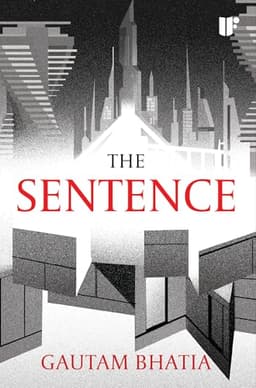
The Sentence
4.2 / 5The Sentence turns one futuristic punishment into a sharp argument about who gets to call violence lawful. Its ideas are richer than some of its characters, but the moral problem lands.
Bibliography
Books by Gautam Bhatia
Reviews and book guides open on Book Review Guide. The full list comes from the linked bibliography source.
Reviewed
The Sentence
Not reviewed yet
Lie
Not reviewed yet
Eternal stone
Not reviewed yet
Comic Century
Not reviewed yet
Laurie Baker, life, work, writings
Not reviewed yet
Malaria dreams and other visions of architecture
Not reviewed yet
A moment in architecture
Not reviewed yet
MUD The House
Not reviewed yet
Punjabi baroque and other memories of architecture
Not reviewed yet
Satish Gujral ; An Artography
Not reviewed yet
A short history of everything
Not reviewed yet
Silent spaces and other stories of architecture
Not reviewed yet
Whitewash
Not reviewed yet
Laurie Baker
Bibliographic source: Open Library.
Books on this site
Gautam Bhatia reviews and guides
20244.2 / 5
The Sentence
A Novel
As an Amazon Associate, I earn from qualifying purchases.
Keep exploring