Biography and criticism
Satirist, dystopian, and restless seeker
Brave New World made Huxley a permanent reference point, but it is only one stage in a career shaped by inherited intellectual privilege, damaged eyesight, spiritual experiment, and distrust of easy certainty.
A famous family and a changed education
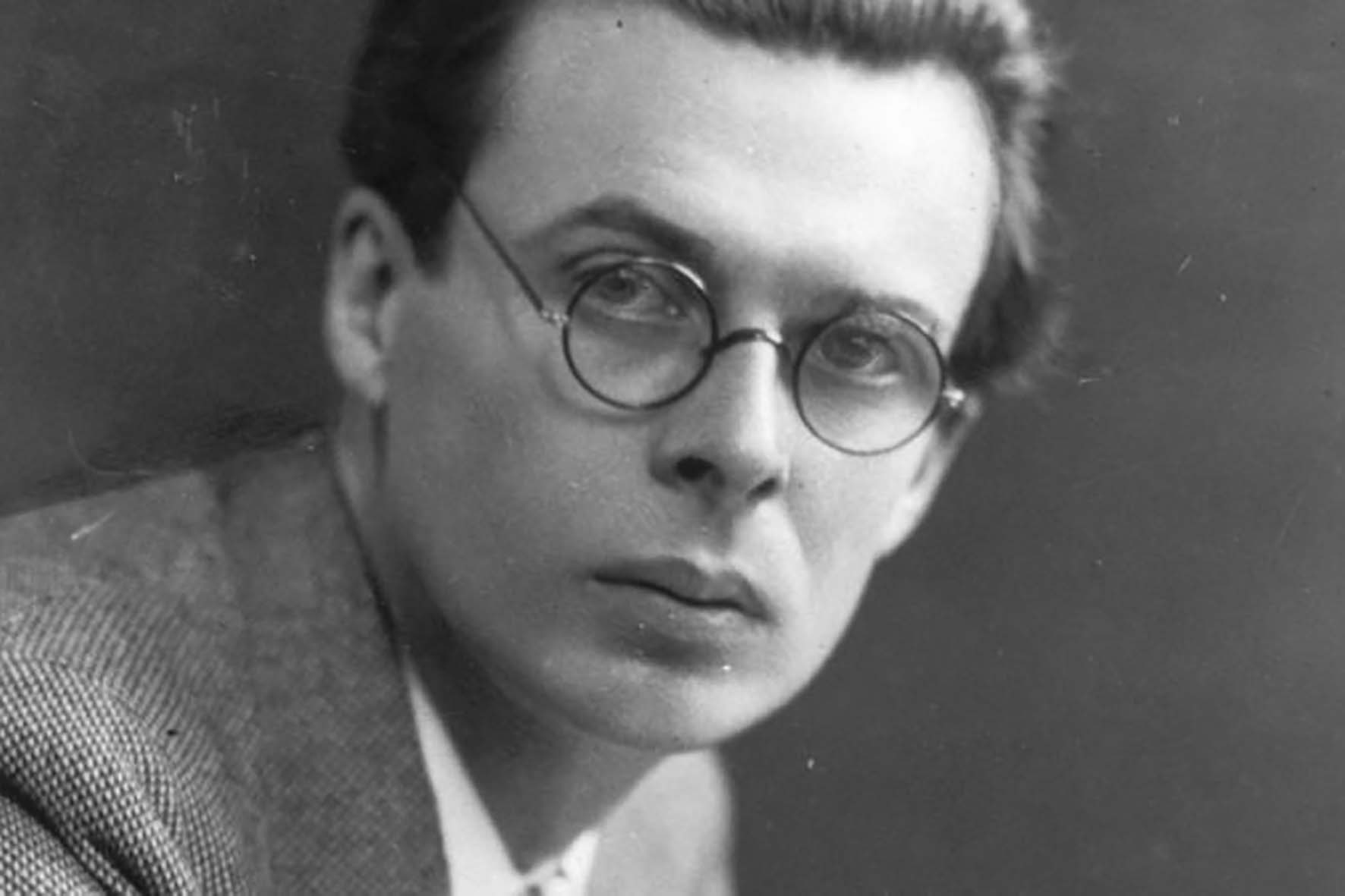
Aldous Leonard Huxley was born in 1894 into a family already prominent in British intellectual life. His grandfather Thomas Henry Huxley had defended Darwin's evolutionary theory, his father Leonard edited and taught, and his brother Julian became a biologist and public intellectual. That inheritance offered extraordinary access but also placed science, religion, education, and social authority inside ordinary family conversation. Huxley attended Eton and planned a medical career before keratitis severely damaged his sight as a teenager. The illness did not leave him permanently blind, but it narrowed his options and changed the practical conditions under which he read and wrote.
He studied English literature at Balliol College, Oxford, and entered the literary world through poetry, journalism, teaching, and the social circles surrounding figures such as Lady Ottoline Morrell. His early novels, including Crome Yellow, Antic Hay, and Point Counter Point, are comedies of intelligent people using ideas as social instruments. Huxley could reproduce an argument fluently and still expose the vanity, fear, or appetite beneath it. This capacity for intellectual mimicry remained central even when the comedy darkened.
The nightmare of painless control
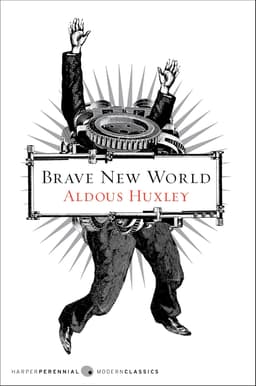
Brave New World appeared in 1932, amid debates about industrial standardization, eugenics, mass entertainment, and political planning. Its World State does not depend primarily on secret police or constant visible pain. Human beings are manufactured into castes, conditioned to desire their assigned functions, distracted by consumption and sex, and pacified by soma. The novel's lasting force comes from this inversion. Repression is not abolished; it is redesigned as satisfaction. Citizens defend the system because their desires have been prepared in advance.
Huxley is sharper at social arrangement than at inward character. Bernard Marx, Lenina Crowne, Helmholtz Watson, and John the Savage embody conflicting forms of dissatisfaction, but they can feel like positions in an argument. The book's comedy is often cruel, and parts of its sexual and racial vocabulary have aged badly. Yet its central questions remain difficult: what kind of freedom survives when comfort is compulsory, what art requires from suffering, and whether a society can eliminate instability without eliminating adulthood.
From skepticism toward mysticism
Huxley's later career complicates the image of the detached satirist. He moved to the United States in the late 1930s, worked in and around Hollywood, and became increasingly interested in pacifism, comparative religion, meditation, and what he called the perennial philosophy. The change was not a clean conversion from reason to faith. He remained attracted to systems that promised direct knowledge while also worrying about manipulation and self-deception. The Perennial Philosophy gathers mystical claims across traditions; The Doors of Perception records his experience with mescaline; Island imagines a society trying to use education, attention, and spiritual practice more humanely than the World State.
This period makes Huxley both more generous and more vulnerable. His willingness to cross boundaries between literature, psychology, religion, and pharmacology opened questions that later countercultures would embrace. It also encouraged sweeping syntheses whose historical differences can disappear under the claim of a universal truth. A serious reading should preserve both facts: Huxley was unusually alert to the manufactured self, and he sometimes preferred a grand pattern to the stubborn particulars that resist it.
Clear arguments, distant characters
Huxley's prose is clear, well read, and built around argument. He likes reversals and scenes in which several educated people expose one another's blind spots. He often treats a room, face, or ritual as evidence of a wider social problem. The essays and dystopias move quickly as a result, but the characters can feel like examples in an argument rather than people you know.
He died in Los Angeles in 1963, on the same day as C. S. Lewis and John F. Kennedy. His reputation still concentrates on Brave New World, yet the wider career explains why that novel is more than a prediction game. Huxley spent his life asking who trains perception, who benefits from appetite, and whether consciousness can be educated without being colonized. Those questions connect the young satirist to the later mystic, even when their answers do not sit comfortably together.