Book comparison
Fourth Wing vs Iron Flame
Fourth Wing is the cleaner entry point. Iron Flame is bigger, darker, and more politically crowded, but it is a sequel and should never be purchased as a substitute for book one.

The buying decision
Buy Fourth Wing first; choose Iron Flame only as the continuation
Fourth Wing is Empyrean book one and introduces Violet, Basgiath, dragon bonding, the war, and the central relationship. Iron Flame is book two. It assumes the first book's ending, expands the political field, and tests established relationships through pressure and withheld information.
Comparing Fourth Wing and Iron Flame as competing fantasy romances creates the wrong decision. They are consecutive parts of Violet Sorrengail's story. A new reader should not choose the one with the preferred cover or larger page count. The only sensible entry is Fourth Wing.
The comparison becomes useful after book one, when a reader wants to know whether the sequel doubles down on the same pleasures or changes the balance. It changes the balance. Fourth Wing has the stronger contained shape: admission, training, survival, bonds, and a central mystery move through one academic year. Iron Flame widens the geography and conspiracy while repeatedly interrupting trust.
The choices
What each book actually offers
These notes avoid revealing the outcomes of trials, relationships, or the final chapters.
Book 1
Fourth Wing
The stronger entry point
Violet enters a brutal rider college with physical disadvantages, book knowledge, and no guarantee that a dragon will tolerate her. The school calendar and survival tests keep the exposition attached to immediate goals.
Buying decision: Buy it if dragons, competitive training, explicit romance, and fast reversals are the draw. It is accessible, but its violence and sexual content make it adult romantasy rather than a children's school fantasy.
Book 2
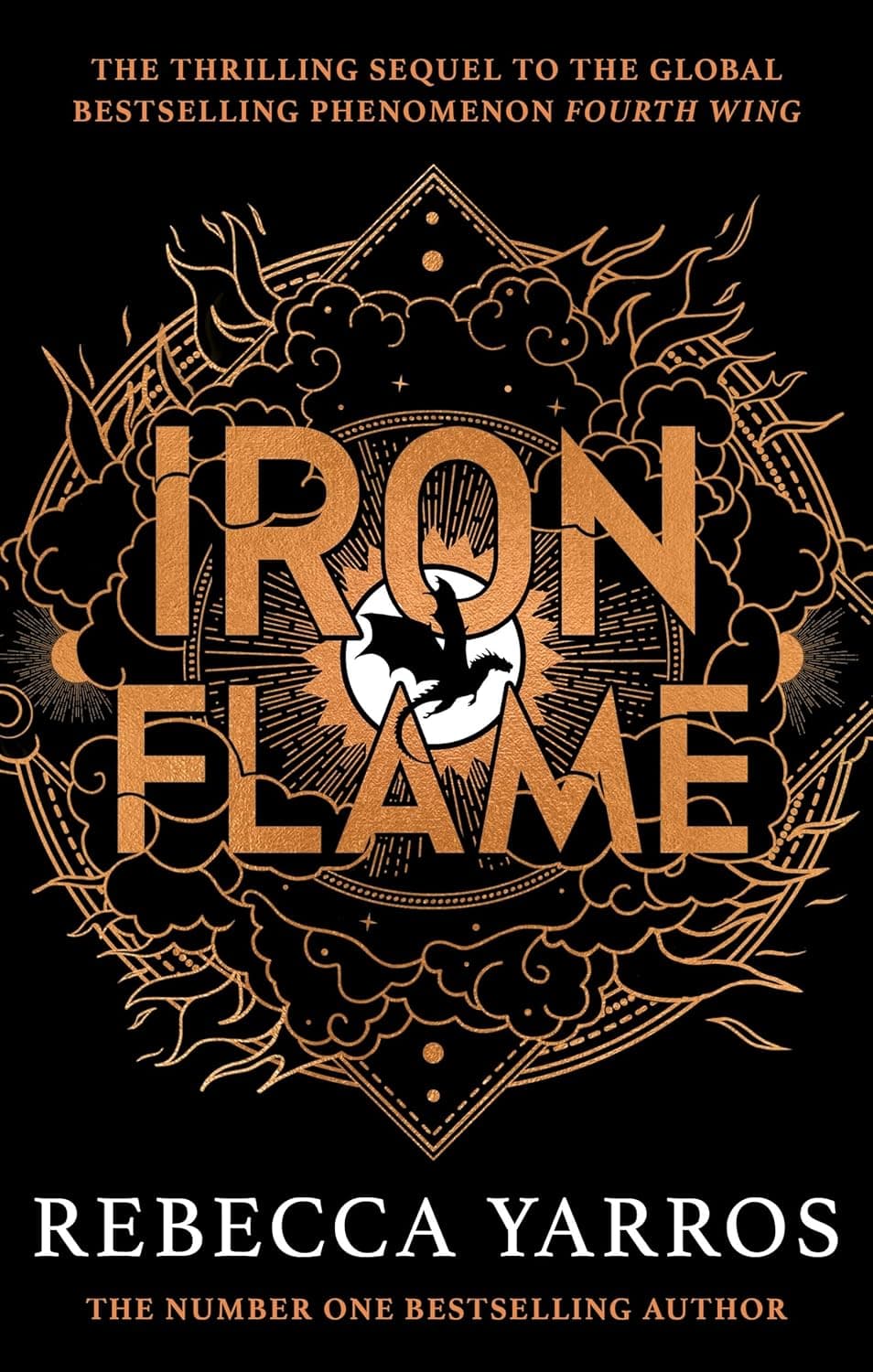
Iron Flame
The larger, rougher sequel
Training continues under harsher authority while the world outside Basgiath becomes harder to ignore. More factions, travel, secrets, and magical questions compete for space, making the book feel broader and less cleanly shaped.
Buying decision: Buy it after Fourth Wing if you want consequences and expansion. Skip the immediate purchase if repeated relationship conflict and a denser middle were already your least favorite parts of book one.
Side by side
Fourth Wing and Iron Flame side by side
The labels describe emphasis, not a claim that one book contains none of the other's qualities.
| Question | Fourth Wing | Iron Flame | Who benefits |
|---|---|---|---|
| Series position | Book 1 | Book 2 | Every new reader starts with Fourth Wing |
| Structure | Focused school survival arc | Broader war, travel, and institutional conflict | Choose the sequel for expansion, not neatness |
| Pace | Fast and visibly goal-driven | Fast scenes inside a longer, more crowded book | Fourth Wing feels more immediately propulsive |
| Romance | Attraction, rivalry, and discovery | Established attachment under secrecy and mistrust | Iron Flame suits readers willing to revisit trust repeatedly |
| Worldbuilding | Introduced through training | More history, factions, mechanics, and geography | Choose Iron Flame if you wanted Fourth Wing to widen the map |
| Darkness | Frequent lethal danger | Harsher control, war pressure, and sustained consequences | Both require comfort with violence |
| Reading effort | Accessible terminology with a clear framework | More names, motives, and moving parts | Fourth Wing is easier to follow |
| Ending | A strong demand to continue | Another major continuation point | Neither is the completed Empyrean story |
What improves in Iron Flame
The war stops feeling like distant justification for a dangerous school. Authority has clearer methods of controlling knowledge, and Violet must decide how information should move rather than merely discover that adults have lied. The dragons also operate within a wider network of loyalties and constraints.
Readers who wanted more than training competitions receive more political geography and a sharper sense that Basgiath is one institution inside a damaged system.
What becomes more frustrating
Iron Flame adds material faster than it gives every thread room to breathe. The relationship conflict repeatedly returns to secrecy, definitions of trust, and who is entitled to which information. That conflict is understandable under wartime conditions, but its recurrence can make emotional progress feel reversible.
The larger cast and shifting objectives also reduce the satisfying clarity that Fourth Wing gets from each immediate trial. More world does not always mean a better-shaped novel.
What to buy after Iron Flame
Onyx Storm is Empyrean book three, officially described by Rebecca Yarros as the follow-up to Fourth Wing and Iron Flame. Continue there rather than jumping to a summary. The series remains ongoing, so buying all currently available volumes is a commitment to an unfinished sequence.
Quick answers
Questions readers ask before buying
Can I read Iron Flame without Fourth Wing?
No sensible first-time order supports that. Iron Flame is a direct sequel and assumes the relationships, rules, revelations, and ending of Fourth Wing.
Is Iron Flame more romantic than Fourth Wing?
It devotes substantial space to the relationship, but much of that space concerns trust and secrecy rather than the discovery-stage tension that drives Fourth Wing.
Which book is easier to read?
Fourth Wing. Its school structure makes goals and terminology easier to place. Iron Flame introduces more locations, factions, and strategic information.
Sources
Sources for this guide
Order, series status, and official starting-point claims were checked against these author and publisher pages on August 2, 2026.
Keep reading