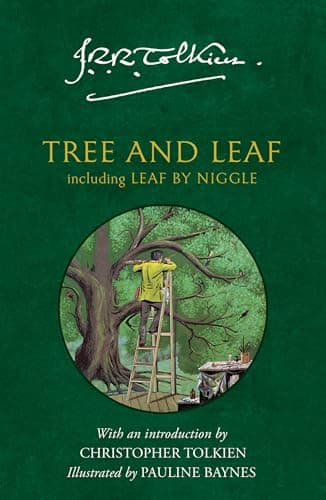
Should you read Tree and Leaf?
What works
On Fairy-Stories defends escape, recovery, and consolation with rigor, while Leaf by Niggle turns artistic incompletion and obligation into lived narrative.
What may not work for you
The essay's scholarly references and long clauses are demanding, and edition contents vary enough that buyers should check what is included.
What may test your patience
On Fairy-Stories builds definitions slowly before reaching its most memorable claims about escape and eucatastrophe.
Does the ending reward the effort?
Leaf by Niggle provides the emotional completion the argument needs, leaving creation larger than either private ambition or public usefulness.
Reading Tree and Leaf closely
Tree and Leaf pairs Tolkien's essay On Fairy-Stories with Leaf by Niggle, letting literary theory and fiction illuminate one another.
The essay defends fantasy, recovery, escape, consolation, and sub-creation; Niggle turns those ideas into a moving story about art, duty, mortality, and grace.
Why fantasy matters
Tolkien treats escape as a potentially honorable resistance to confinement rather than a refusal of reality.
Essay beside story
The essay can be demanding, but Niggle gives its creative questions emotional form.
Three useful comparisons
Leaf by Niggle
Leaf by Niggle alone offers the fiction without the demanding critical framework.
Best for: Artists, Tolkien readers, and anyone drawn to brief philosophical fantasy about incompletion and grace.
The Monsters and the Critics, and Other Essays
Monsters and the Critics is broader, more academic, and essential for Tolkien's medieval scholarship.
Best for: Readers of medieval literature, Tolkien scholars, and advanced fans interested in the intellectual foundations of his fiction.
Tales from the Perilous Realm
Perilous Realm offers more fiction and tonal variety, often including Leaf by Niggle.
Best for: A substantial collection of Tolkien's shorter, stranger, and often funnier work.