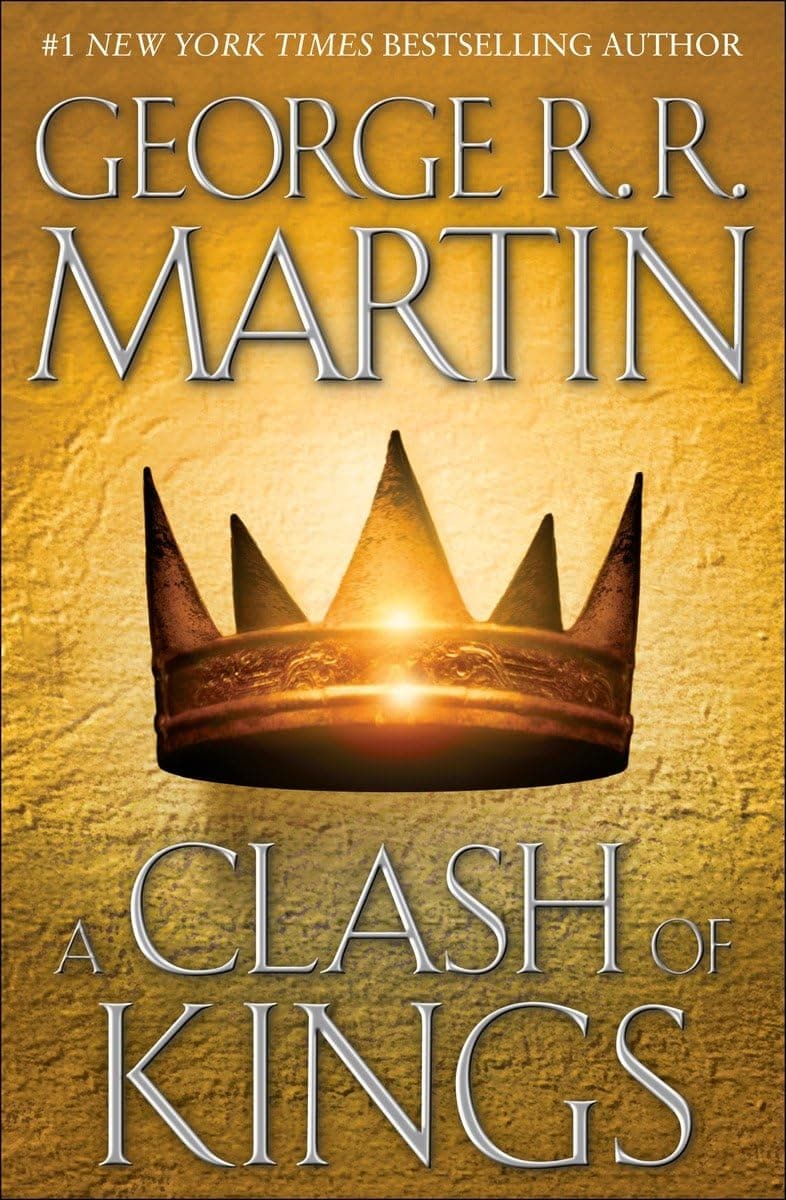
Should you read A Clash of Kings?
What works
Tyrion's defense of King's Landing, Arya's captivity, and the multiplying kings show power operating at radically different social levels.
What may not work for you
Theon and Daenerys move unevenly, sexual violence remains pervasive, and the widening geography delays several favorite viewpoints.
What may test your patience
Travel and military positioning dominate stretches of the middle before the Blackwater gathers multiple plans into one event.
Does the ending reward the effort?
Yes. The battle pays off political preparation and character choices while leaving victory morally and strategically unstable.
Reading A Clash of Kings closely
A Clash of Kings takes the pieces set up in A Game of Thrones and scatters them across a continent at war. Rival kings rise, a red comet blazes overhead, and armies move by land and sea while winter edges closer. Instead of a single clear front, the conflict splinters into sieges, raids, and political gambits that show how messy civil war really looks.
The rotating point of view chapters feel like walking between different battle maps. One moment you are in a smoky war room planning naval attacks, the next you are following a child on the run or a young queen in exile. Big set pieces, including the Battle of the Blackwater, hit hard because Martin builds them slowly, scene by scene, with choices that make grim sense even when they hurt.
Characters who might have looked like archetypes in the first book become stranger and more human here. Supposed villains reveal principles, apparent heroes reveal blind spots, and ordinary people keep stealing scenes by trying to survive in the margins. Nobody floats above consequence, which makes even small decisions feel like loaded dice throws.
Martin's prose stays tactile and grounded in weather, food, ship decks, and the weight of armor. Magic is still present, but it creeps along the edges of the story like rumor and omen rather than constant spectacle. If you want to keep track of timelines or house histories while you read, spoiler aware resources such as Westeros.org can be surprisingly helpful.
Three useful comparisons
A Game of Thrones
A Game of Thrones is tighter and more family-centered; Clash expands the conflict and supernatural pressure.
Best for: Start here for adult epic fantasy built from family politics, moral consequence, violence, and a large cast with conflicting loyalties.
A Storm of Swords
A Storm of Swords delivers faster reversals and the strongest cumulative payoffs in the series.
Best for: Readers invested in the first two volumes and prepared for extreme violence, betrayal, war, and transformative character turns.
The Two Towers
The Two Towers also divides a company across war and hostile travel, but with stronger mythic unity and less political cynicism.
Best for: Readers continuing the trilogy who welcome divided viewpoints, war, moral ambiguity, and a slower journey into hostile land.
Make the next decision
Reading and buying guides featuring A Clash of Kings
Series buying note
Would the collection be the better buy?
These are useful only when you want several books in the same run. The notes below spell out what each package includes and, just as importantly, what it leaves out.
Five-book paperback box set
A Song of Ice and Fire 5-Book Boxed Set
This set collects all five published main-sequence novels, which is exactly what a new reader needs to catch up with the unfinished story.
Included: A Game of Thrones, A Clash of Kings, A Storm of Swords, A Feast for Crows, A Dance with Dragons
Our buying note: The box does not contain The Winds of Winter, and the planned seven-book sequence is not complete. Buy it for the five novels that exist, not as a finished saga.