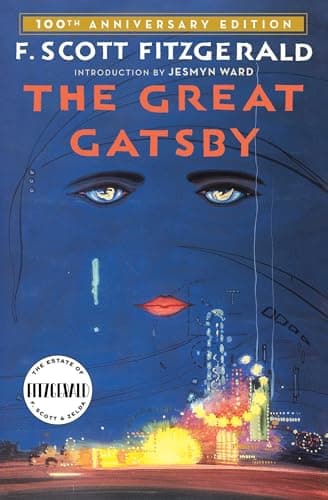
Should you read The Great Gatsby?
What works
Nick's attraction to Gatsby never cancels his judgment. That divided perspective lets the parties, houses, clothes, and gestures remain seductive while the novel reveals what wealth allows people to avoid.
What may not work for you
Daisy is seen so heavily through Gatsby and Nick that her inner life remains restricted, and the symbolic machinery can feel conspicuous once the green light and ash heaps are familiar from classroom discussion.
What may test your patience
The opening dinner and early party scenes introduce social connections before Gatsby becomes emotionally legible. The book is short, but its first chapters deliberately make the reader look at surfaces.
Does the ending reward the effort?
Yes. The close widens one man's failed reinvention into a larger argument about desire and the American past without pretending that lyrical understanding produces justice.
Reading The Great Gatsby closely
The Great Gatsby filters Jay Gatsby's carefully staged world through Nick Carraway, a participant who presents himself as a restrained observer. Gatsby's parties, wealth, and invented biography all serve one private project: recovering a past with Daisy Buchanan that reality cannot reproduce.
Fitzgerald's short novel works through compression. Repeated images such as the green light, ash heaps, cars, houses, and watching eyes connect romantic obsession to class privilege and an American dream already distorted by inherited money.
Gatsby through Nick's eyes
Nick's admiration and criticism coexist, making his narration part of the novel's uncertainty. Gatsby can appear hopeful and dangerously committed to illusion at the same time.
Short but symbolically dense
The plot moves quickly and the prose is approachable, though historical context about the Jazz Age, Prohibition, and class makes its social argument clearer.
Three useful comparisons
Pride and Prejudice
Pride and Prejudice also connects love with money and status, but believes self-knowledge can create a viable partnership. Gatsby presents desire as projection and class mobility as a fatal illusion.
Best for: Readers who enjoy slow-burn romance, social comedy, and protagonists intelligent enough to be convincingly wrong.
The Picture of Dorian Gray
The Picture of Dorian Gray offers more wit, decadence, and overt Gothic consequence. Choose Gatsby for restraint and social precision; choose Dorian Gray for moral corruption made supernatural.
Best for: Readers who enjoy Gothic corruption, social wit, queer subtext, and novels suspicious of their own beautiful surfaces.
To Kill a Mockingbird
To Kill a Mockingbird also uses a retrospective narrator to reconsider an American community, but centers childhood moral education and public injustice rather than adult longing and wealth.
Best for: Readers and classrooms prepared to value Scout's moral growth while also discussing the novel's limited perspective on Black experience.