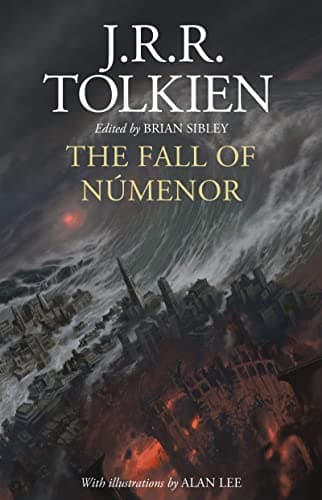
Should you read The Fall of Númenor?
What works
Arranging events year by year clarifies Númenor's rise, corruption, Sauron's strategy, and the path toward the Last Alliance.
What may not work for you
Sources vary in detail and register, connective editorial material cannot remove every gap, and character intimacy remains limited.
What may test your patience
Annals and compressed years sometimes replace scenes just when a political change becomes interesting.
Does the ending reward the effort?
Yes. The catastrophe and Last Alliance give the age a complete historical contour and lead naturally into The Lord of the Rings.
Reading The Fall of Númenor closely
The Fall of Númenor arranges Tolkien's scattered Second Age writings into a single chronological account following Númenor, Sauron, the Rings, and the Last Alliance.
Brian Sibley's structure and Alan Lee's illustrations provide an accessible path through material otherwise distributed across several books.
A Second Age chronicle
The editor reorganizes existing Tolkien texts rather than inventing a new continuous novel.
Three useful comparisons
Unfinished Tales of Númenor and Middle-earth
Unfinished Tales provides source context and broader material but less chronological continuity.
Best for: Readers already familiar with The Lord of the Rings and The Silmarillion who enjoy textual history alongside lore.
The Silmarillion
The Silmarillion covers much more time and gives Númenor only a compressed central account.
Best for: Committed Middle-earth readers who enjoy mythology, tragic history, invented languages, and repeated reading more than conventional character access.
Fire and Blood
Fire & Blood offers a more cynical dynastic pseudo-history with disputed narrators and stronger character scandal.
Best for: Targaryen enthusiasts and readers who enjoy dynastic pseudo-history, unreliable sources, and political succession more than close viewpoint fiction.