Edition and film context
The 2012 novel and the 2026 movie tie-in are the same work in different editions
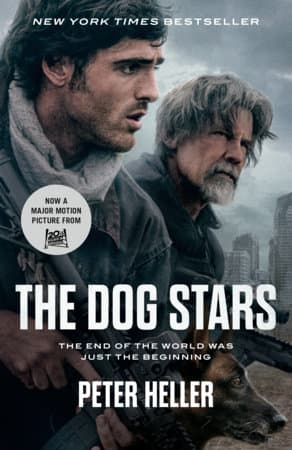
Peter Heller's novel was first published in 2012. Vintage published a 336-page movie tie-in paperback on August 4, 2026. Disney's UK press site lists the film in cinemas from August 26, while 20th Century Studios lists August 28 for the United States.
- Original novel
- First published in 2012
- Movie tie-in paperback
- Published August 4, 2026 by Vintage; 336 pages; ISBN 9798217009312
- Film
- Directed by Ridley Scott; in cinemas from August 26, with the United States release on August 28
- Series status
- Listed by the author and publisher as a standalone novel, not a numbered series
Primary sources: Penguin Random House edition page, Peter Heller official book page, 20th Century Studios film page, Disney UK press kit
Should you read The Dog Stars?
What works
Hig's desire to keep fishing, flying, helping strangers, and talking to Jasper gives survival an emotional purpose. Bangley's ruthless perimeter logic is an effective counterweight, while the living landscape keeps beauty from becoming a sentimental escape from danger.
What may not work for you
The later romantic movement arrives with less patient development than Hig's bonds with Jasper and Bangley. A few bursts of brutality also feel engineered to jolt a contemplative novel back into thriller mode rather than growing cleanly from its quieter rhythms.
What may test your patience
The opening repeats patrols, supply calculations, memories, and fragments of daily routine before the radio signal becomes a journey. Readers who resist missing punctuation, clipped clauses, and abrupt time shifts may need fifty pages to hear Hig's cadence rather than fight it.
Does the ending reward the effort?
Yes. Without pretending grief can be completed, the ending turns hope into a difficult practice of trust, care, and renewed obligation. Some resolutions are neater than the book's harshest passages suggest, but its emotional direction is earned.
Reading The Dog Stars closely
Nine years after a flu pandemic has emptied most of the country, Hig lives at an abandoned Colorado airfield with Jasper, his dog, and Bangley, a heavily armed survivalist who treats every unknown person as a threat. Their arrangement works because each man supplies what the other lacks. Bangley can secure a perimeter and make a lethal decision without hesitation. Hig can fly the 1956 Cessna, patrol beyond the fence, and remember that staying alive is not the same as having a life.
Hig's grief is the novel's real climate. He misses his wife and the vanished ordinary world, but Heller does not turn him into a permanently solemn symbol. He fishes, notices light on water, talks to Jasper, irritates Bangley, and keeps helping people beyond the airfield even when prudence says he should stop. His impulses are not always wise. They are the evidence that catastrophe has not reduced him to Bangley's efficient arithmetic of ammunition, fuel, and distance.
Jasper is essential because the relationship gives Hig intimacy without requiring an explanation of every feeling. Heller makes the dog alert, physical, and companionable rather than a cute accessory placed in the ruins. Bangley offers the opposite bond: abrasive, mostly unspoken, and built through complementary labor. Their exchanges have a dry comic pressure because both men understand how much they depend on someone whose view of humanity they do not share.
The prose is the sharpest dividing line. Hig's first-person sentences break apart, omit connective words, and jump between present sensation and memory. At first the effect can resemble a style being announced too loudly. Once its rhythm settles, the omissions begin to sound like thought shaped by loneliness: quick inventory under danger, then sudden lyric attention when weather, altitude, river water, or an animal interrupts the defensive routine. Heller writes nature as a surviving presence, not scenery waiting for people to recover it.
The structure follows that tension between enclosure and desire. Early chapters circle the same patrol range, chores, losses, and rules until a broken radio transmission offers a possibility beyond the safe return limit of Hig's plane. The later journey gives the novel more conventional suspense, violence, and human contact. It also exposes a weakness: the romantic material is emotionally legible but develops more quickly and neatly than the painstaking bonds at the airfield.
Violence arrives abruptly and can be ugly, but the book is not interested in making brutality look like competence. Bangley's pragmatism often keeps the men alive, while Hig's acts of mercy preserve something survival alone cannot justify. The strongest moral pressure comes from refusing to make either position sufficient. The ending leans toward hope without cancelling grief or pretending trust has become safe. That balance is why The Dog Stars stands apart from a routine apocalypse thriller: it asks not only how a person survives loss, but what forms of attention make survival worth continuing.
Hig is a survivor who still wants a life
Hig is capable with a plane, rifle, and fishing rod, but competence is not his defining trait. He keeps testing whether kindness, curiosity, and beauty still have practical room in a world that punishes openness. His mistakes grow from that refusal to become only a guard at the edge of an airfield.
Grief makes his narration discontinuous. Memories of his wife enter without ceremonial transitions, as if the past remains mixed into the present rather than stored safely behind it. The novel is most affecting when Hig does not explain the feeling and lets an object, place, or habit carry it.
Jasper and Bangley keep the novel grounded
Jasper gives Hig uncomplicated presence: movement, attention, warmth, and a reason to return. Their bond is written through shared routines rather than sentimental speeches. The emotional force comes from how completely Hig has rebuilt daily life around another creature.
Bangley is harder and just as important. He can look like a stock armed survivalist, yet his relationship with Hig gradually reveals loyalty through logistics, vigilance, and irritated trust. The book never fully settles their argument over whether mercy is courage or a liability.
Nature survives without becoming innocent
Flying changes the scale of the ruins. From the Cessna, roads and towns become traces inside a larger landscape, while fuel range turns every glimpse of distance into a calculation. Fishing and camping do not provide a pure retreat from human violence, but they let Hig experience attention without defense for a moment.
Heller's outdoor writing is exact enough to resist generic pastoral comfort. Weather, animals, water, and terrain can nourish, conceal, expose, or kill. Nature offers beauty after civilization, not moral safety.
Pacing, violence, and the patience point
The first half is deliberately circular. Patrols, flights, supply runs, and memories establish how small Hig's survivable world has become. The radio signal eventually creates a line of movement, but readers expecting immediate chase plotting may find the routine slow.
Later confrontations are quick and severe. They prevent the novel's hope from floating free of danger, although one or two shocks feel more forceful than necessary. This is dark adult fiction, not a gentle story about a man and his dog.
Does the ending work?
The ending is more hopeful than the novel's premise suggests, but it does not define hope as a restored version of the old world. It asks Hig to accept new obligations and new uncertainty instead of retreating into memory or perimeter defense.
A few pieces settle with convenient speed, especially compared with the long isolation that precedes them. The emotional conclusion still works because it completes Hig's movement from merely protecting a life toward choosing what that life is for.
The Dog Stars and Ridley Scott's film
Ridley Scott directs the film, with Jacob Elordi as Hig and Josh Brolin as Bangley. Margaret Qualley, Guy Pearce, Benedict Wong, and Allison Janney also appear. Disney's UK press kit lists the film in cinemas from August 26, 2026; 20th Century Studios lists the United States release for August 28.
That context stays compact because the novel review remains the evergreen focus. For the separate spoiler-free timing decision, see Should you read The Dog Stars before the movie?
The 2026 movie tie-in edition
Vintage published the movie tie-in paperback on August 4, 2026. Penguin Random House lists it at 336 pages with ISBN 9798217009312. The novel itself remains the work first published in 2012; the new date and film artwork identify this edition, not a revised story.
Confirm the ISBN and cover if the tie-in is the version you want.
Where to go next
Visit the Peter Heller author page for his fiction and nonfiction, or use Books Like The Dog Stars to compare eight reviewed alternatives by literary aftermath, solitude, practical survival, ecology, and renewed connection.
Three useful comparisons
The Road
The Road is bleaker, more austere, and almost entirely narrowed to a father and son moving through ash. The Dog Stars keeps a defended home, a plane, a dog, dry humor, and a stronger faith that beauty and new connection can survive. Choose McCarthy for severity; choose Heller for grief that still reaches outward.
Best for: Readers prepared for severe post-apocalyptic fiction centered on parenthood, moral endurance, and grief rather than worldbuilding.
Never Let Me Go
Never Let Me Go also makes speculative catastrophe secondary to memory and attachment, but its calm retrospection hides institutional violence inside ordinary life. Heller is rougher, bloodier, and more physically exposed. Choose Ishiguro for restraint and Heller for wilderness, danger, and a more openly hopeful arc.
Best for: Readers who value quiet speculative fiction, friendship, memory, and emotional implication over plot-driven rebellion.
The Martian
The Martian turns isolation into brisk engineering, procedural victories, and comic problem-solving. The Dog Stars cares less about proving every survival calculation than about what competence cannot repair: grief, loneliness, and moral injury. Choose Weir for technical momentum and Heller for voice, landscape, and emotional aftermath.
Best for: Readers who enjoy problem solving, survival logistics, accessible science, and a protagonist who meets disaster with jokes.
Make the next decision