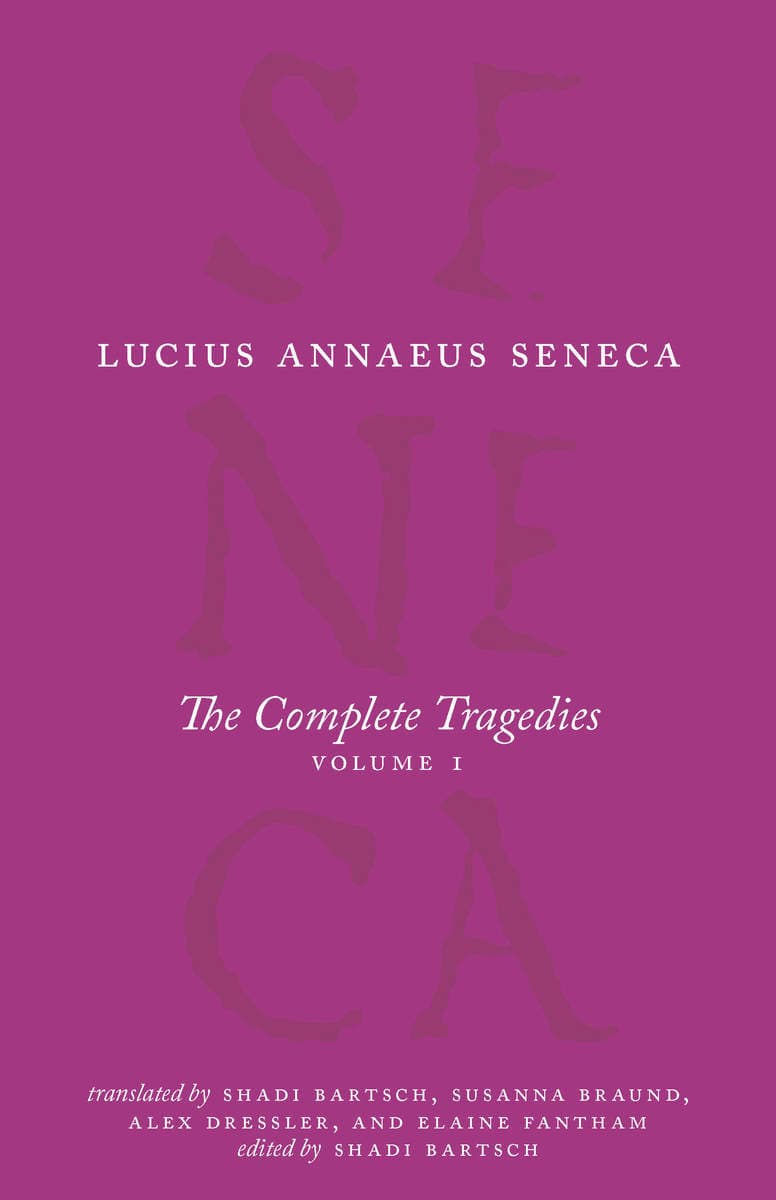
Should you read The Complete Tragedies, Volume 1?
What works
Medea's self-conscious construction of revenge is terrifying, Phaedra makes desire and accusation politically lethal, and The Trojan Women refuses to let victory silence its captives. Separate translators preserve distinct rhythms while the introductions clarify each play's relation to earlier Greek versions.
What may not work for you
The Phoenician Women survives as an incomplete drama, so its promising family confrontation has no fully shaped ending. Octavia was written in imitation of Seneca rather than by him, and reading all five plays in sequence can make repeated prophecies, laments, and cosmic claims feel mechanically similar.
What may test your patience
The fragmentary Phoenician Women interrupts the momentum after Medea, and readers expecting a finished tragedy may mistake textual survival for deliberate openness. The editorial introduction is essential before judging its abrupt shape.
Does the ending reward the effort?
Yes, if the volume is understood as a curated dramatic record. Octavia shifts from myth into Nero's Rome and ends the collection by showing Senecan language used to stage the imperial world that shaped the philosopher himself.
Reading The Complete Tragedies, Volume 1 closely
The Complete Tragedies, Volume 1 contains Medea, The Phoenician Women, Phaedra, The Trojan Women, and Octavia. The first four belong to the Senecan tragic corpus, although The Phoenician Women is incomplete. Octavia is an anonymous Roman play written in Seneca's dramatic tradition and featuring Seneca as a character, not a tragedy authored by him.
Medea is the immediate center. Seneca's protagonist understands the cultural story attached to her name and speaks as if she must become equal to it. Betrayal, exile, and injured status harden into an act of self-creation through revenge. The language is not a transparent report of emotion. It is part of the mechanism by which emotion becomes intention.
Phaedra similarly treats desire as an argument a person makes to herself before it becomes an accusation with public consequences. The Phoenician Women offers a raw confrontation within the house of Oedipus but breaks off without a finished dramatic architecture. The incompleteness is historically important and emotionally frustrating, especially after Medea's severe control.
The Trojan Women shifts attention to captives facing decisions made by victorious men and sanctioned through ritual. Its laments are not pauses in the action; they preserve memory and expose the cost hidden by military triumph. Octavia then moves from mythic dynasties into Nero's Rome, using Senecan techniques to stage imperial marriage, popular anger, and political helplessness.
The translators, Shadi Bartsch, Susanna Braund, Alex Dressler, and Elaine Fantham, maintain readable verse while allowing each play a distinct cadence. The volume needs its introductions because authorship, source traditions, textual gaps, and Roman performance all affect what appears on the page. It is an excellent scholarly edition and a grim, uneven, powerful dramatic collection.
Medea speaks herself toward catastrophe
Her rhetoric does not simply express a completed decision. Repetition, invocation, memory, and comparison help construct the identity capable of carrying revenge through.
Defeated women keep the history of war
The Trojan Women refuses the victor's clean ending. Lament records names, bodies, families, and futures that official triumph would prefer to convert into background.
Octavia is Senecan, not by Seneca
The anonymous play imitates Senecan tragedy and places the philosopher within Nero's court. Its inclusion shows the political afterlife of his dramatic style, but readers should not attribute the work to Seneca himself.
Three useful comparisons
The Complete Tragedies, Volume 2
Volume 2 contains Oedipus, two Hercules plays, Thyestes, and Agamemnon, with greater emphasis on male heroic collapse and cannibal revenge. Volume 1 offers stronger attention to women confronting betrayal, war, and political power. Read both for the corpus; choose Volume 1 first if Medea or Troy is your entry point.
Best for: Readers of Roman drama, revenge tragedy, mythic horror, classical reception, and Shakespearean or Jacobean tragedy, especially those willing to read introductions and notes and to treat each play as a separate encounter.
The Picture of Dorian Gray
The Picture of Dorian Gray uses wit, social scenes, and Gothic secrecy to show desire becoming a theory that excuses harm. Seneca's characters announce desire in a higher, more violent register and move rapidly toward catastrophe. Wilde is more ironic and gradual; Volume 1 is mythic, confrontational, and formally theatrical.
Best for: Readers who enjoy Gothic corruption, social wit, queer subtext, and novels suspicious of their own beautiful surfaces.
The Brothers Karamazov
Dostoevsky gives damaged families hundreds of pages in which motive, belief, resentment, and responsibility remain contestable. The Phoenician Women and Phaedra compress comparable family ruin into formal confrontation and irreversible accusation. Choose the novel for psychological accumulation and Seneca for the stripped architecture of tragic conflict.
Best for: Patient readers who want family catastrophe, murder, theology, moral psychology, and long scenes of people arguing at full intensity.