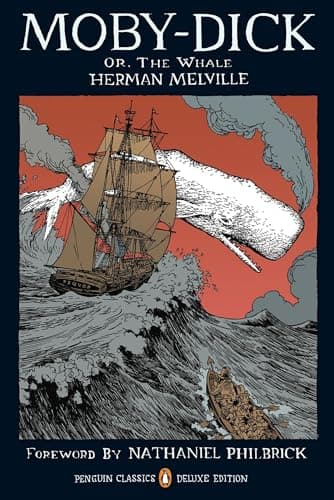
Should you read Moby-Dick?
What works
Melville keeps changing the scale of the book. A friendship in a rented bed, the labor of a whaling crew, a stage-like monologue, and a cosmic argument about an unreadable animal can occupy adjacent chapters without flattening one another.
What may not work for you
The cetology and whaling chapters are far longer than narrative necessity requires, and the novel's treatment of race mixes genuine curiosity with stereotypes and nineteenth-century hierarchy.
What may test your patience
The extended classifications of whales and descriptions of processing blubber are where many readers nearly stop. Skimming them preserves plot, but reading selectively reveals how Ishmael turns failed knowledge into part of the theme.
Does the ending reward the effort?
Completely. Once the chase begins, the accumulated technical detail gives every action weight, and the final image reduces the book's enormous argument to one survivor and an indifferent sea.
Reading Moby-Dick closely
Moby-Dick begins as Ishmael's account of joining the Pequod, then expands into drama, philosophy, comedy, natural history, and maritime labor. Captain Ahab's hunt for the white whale provides the narrative line, but Melville repeatedly leaves it to study the physical and symbolic world surrounding the voyage.
That structure is why the novel can feel difficult and why it remains extraordinary. The whaling chapters slow conventional suspense, yet they turn the ship into a complete working society and make the whale impossible to reduce to one meaning.
Ahab's obsession and Ishmael's curiosity
Ahab forces experience toward a single enemy; Ishmael keeps opening it to more voices, facts, jokes, and interpretations. Their opposing habits shape the book as much as the chase.
How to approach the digressions
Read the cetology and labor chapters as part of the novel's argument about knowledge, not as failed plot. A chapter guide can help without requiring every technical detail to be memorized.
Three useful comparisons
Dune
Dune also builds a civilization around a dangerous resource and an immense creature, but keeps ecology tied to a continuous political plot. Choose it for tighter worldbuilding; choose Moby-Dick for formal wildness.
Best for: Readers willing to trade immediate intimacy for political, ecological, and religious ideas that become more connected with every chapter.
The Brothers Karamazov
The Brothers Karamazov matches Melville's appetite for theological argument and tonal extremes, but anchors those debates in family crime. It is the better choice when psychological conflict matters more than environment.
Best for: Patient readers who want family catastrophe, murder, theology, moral psychology, and long scenes of people arguing at full intensity.
The Road
The Road strips the journey novel to ash, hunger, and one relationship. Its prose is far leaner, offering moral endurance without Moby-Dick's encyclopedic exuberance.
Best for: Readers prepared for severe post-apocalyptic fiction centered on parenthood, moral endurance, and grief rather than worldbuilding.