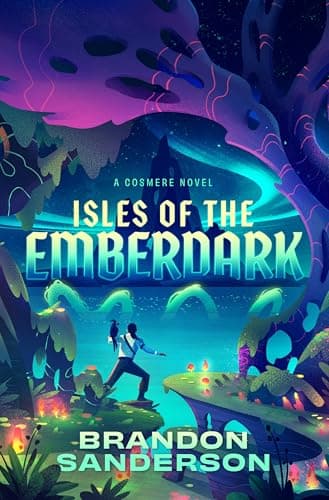
Should you read Isles of the Emberdark?
What works
Island travel, dangerous skies, competing missions, and character discovery give the setting practical wonder rather than static lore.
What may not work for you
Connections can feel like rewards for catalog knowledge, exposition interrupts movement, and some emotional turns arrive after plot machinery has already accelerated.
What may test your patience
The opening must establish local geography, magical rules, and off-world significance before the expedition gains a clear line.
Does the ending reward the effort?
The immediate voyage pays off and the Cosmere implications expand it, though some satisfaction depends on recognizing the wider framework.
Reading Isles of the Emberdark closely
Isles of the Emberdark is officially presented as a standalone novel, but it expands Brandon Sanderson's Sixth of the Dusk into a far-future Cosmere adventure. Dusk is trying to preserve his people's independence as the Ones Above accelerate change around the Aviar, while Starling, a young dragon trapped in human form, searches for a discovery capable of freeing her indebted crew.
Their routes meet in the emberdark, a realm of portals, rival powers, and dead-god consequences. The immediate adventure is readable on its own, but prior Cosmere reading materially changes how much of its wider significance lands. Buy it now if you want a standalone that expands Sixth of the Dusk and welcome those connections; start with our Brandon Sanderson starting guide instead if you want the clearest first introduction to his work.
Tradition against galactic expansion
Dusk understands that refusing change may doom his people, yet accepting the invaders' terms could erase them just as completely. The conflict gives the portal adventure a strong political center.
Three useful comparisons
The Sunlit Man
The Sunlit Man is faster, harsher, and more openly built around planetary survival.
Best for: Cosmere readers wanting a fast planetary survival adventure and newcomers comfortable not understanding every connection.
Mistborn: The Final Empire
Mistborn offers the stronger self-contained starting point and a more disciplined magic introduction.
Best for: A welcoming epic fantasy with rule-based magic, found family, political rebellion, and a complete first-volume payoff.
Shards of Earth
Shards of Earth provides a non-Cosmere ensemble adventure with broader alien politics and found-family warmth.
Best for: Go here for a found-family crew, diverse aliens, political factions, salvage work, and large-scale space-opera danger.
Make the next decision