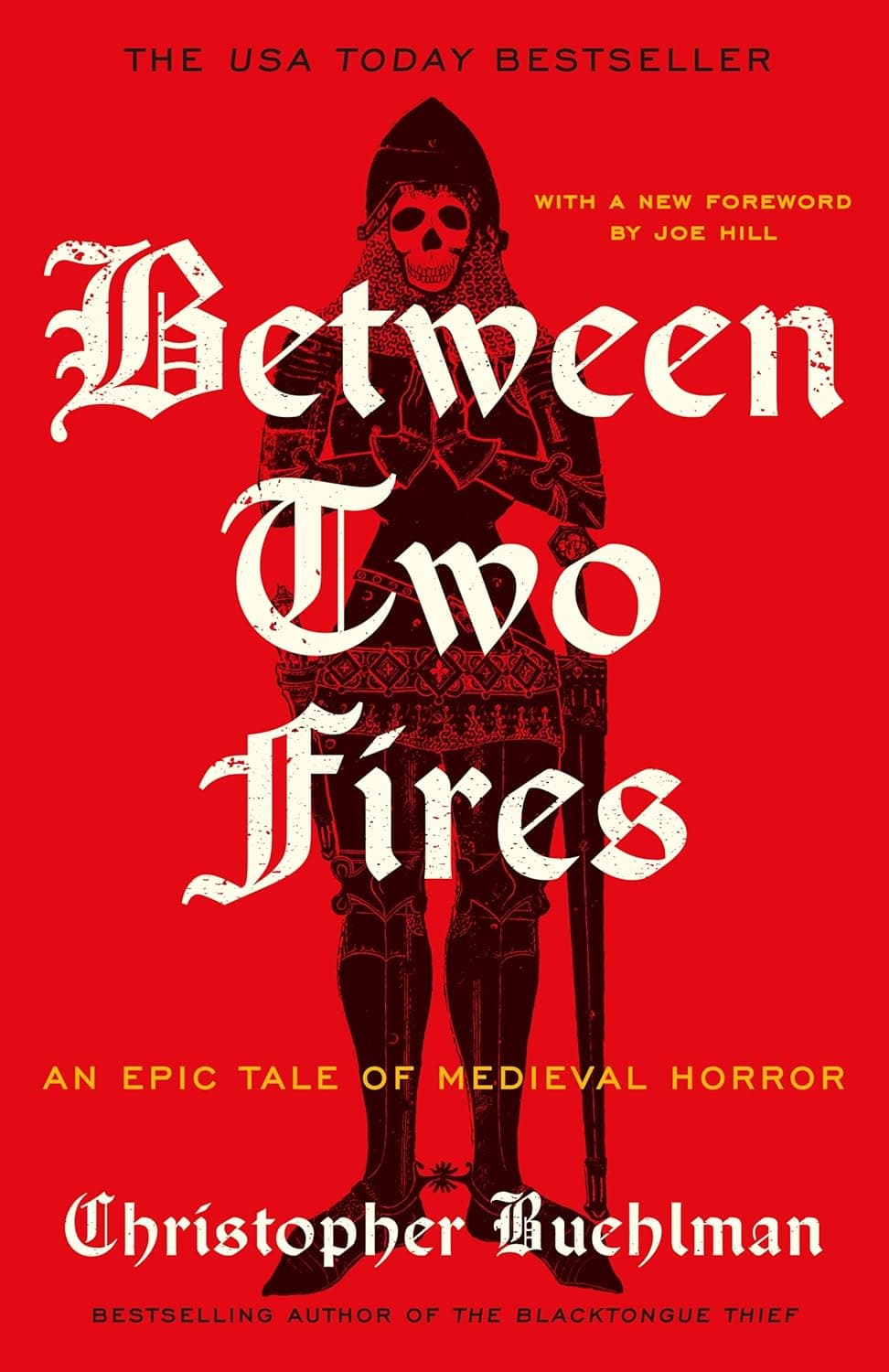
Should you read Between Two Fires?
What works
Thomas, Delphine, and the priest form an unstable moral company, while each monstrous episode grows from a historical or theological fear.
What may not work for you
The episodic journey is relentlessly bleak, sexual violence is present, and symbolic meaning occasionally overtakes character subtlety.
What may test your patience
Successive towns and horrors can feel like stations in an allegorical trial before the destination gives them a common shape.
Does the ending reward the effort?
Yes. The final spiritual and personal reckonings reward the pilgrimage without turning suffering into simple proof of divine order.
Reading Between Two Fires closely
France in 1348 is already collapsing when Thomas meets Delphine in an abandoned Norman village. He is a disgraced knight surviving through violence; she is a young girl who believes she has been given a divine mission in Avignon. Their journey begins as an uneasy act of protection, then becomes harder to classify as plague, brigands, and supernatural visitations turn the road into a test of what either traveler still believes.
Père Matthieu completes the central company and prevents the book from reducing faith to either certainty or fraud. Thomas understands material danger, Delphine sees a cosmic pattern, and the priest must keep interpreting one through the other. Their arguments matter because Buehlman lets affection develop through practical acts: sharing food, tending wounds, keeping watch, and choosing not to abandon someone when departure would be safer.
The novel is episodic by design. Each town presents another form of corruption, grief, or religious terror, and several encounters resemble stations in a medieval vision of hell. That structure gives the book its astonishing images, but it also creates its slowest stretch. Readers waiting for a conventional antagonist may feel the middle repeating its pattern before Avignon gives the pilgrimage a firmer direction.
Buehlman's prose earns the horror by making the period physical. Armor has weight, roads have mud, hunger changes judgment, and plague is experienced through bodies rather than historical explanation. Against that ugliness, the visionary passages expand into grotesque, almost painted tableaux. The movement between soldiers' jokes and sacred dread keeps the novel from becoming solemn allegory, though the violence, including sexual violence, makes it a demanding recommendation.
The ending rewards that severity because redemption does not arrive as a cancellation of pain. Thomas's choices gain meaning through everything the road has taken from him, while Delphine's role remains emotionally legible even when the theology grows dense. This is the rare fantasy horror novel in which the monsters are memorable, but the final measure of success is whether three damaged people can still treat one another as souls rather than instruments.
Three useful comparisons
The Devils
The Devils is funnier, faster, and more irreverent, with a crowded monster squad rather than sacred dread.
Best for: Readers who want profane, violent quest fantasy and enjoy a crowded ensemble more than a lone hero.
The Road
The Road is leaner and secular, but shares a journey where care remains meaningful under near-total ruin.
Best for: Readers prepared for severe post-apocalyptic fiction centered on parenthood, moral endurance, and grief rather than worldbuilding.
A Sorceress Comes to Call
A Sorceress Comes to Call contains its supernatural abuse inside a more humane and socially comic household story.
Best for: Try it for dark fairy-tale revision, coercive-control horror, older heroines, and humane humor.
Make the next decision