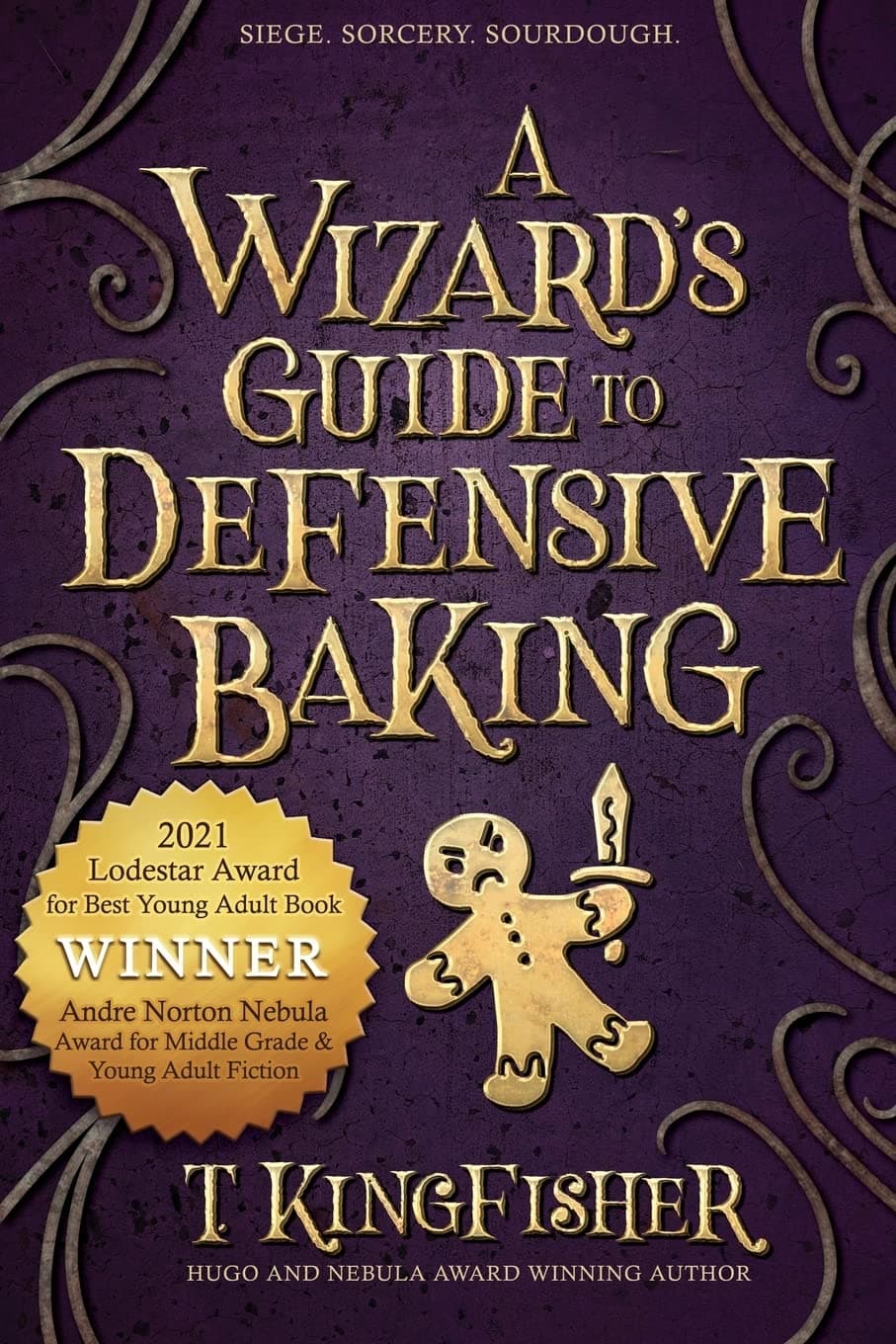
Should you read A Wizard's Guide to Defensive Baking?
What works
Mona solves problems by understanding dough rather than discovering unlimited power, and each absurd use follows from skills established in the bakery.
What may not work for you
The conspiracy and city politics are simpler than Mona's emotional experience, and some villains function mainly as embodiments of institutional cowardice.
What may test your patience
The investigation briefly circles suspicion and official inaction before the siege gives Mona's experiments a clear deadline.
Does the ending reward the effort?
Yes. The climax uses bread magic creatively while refusing to treat a child's successful heroism as evidence that adults were right to depend on her.
Reading A Wizard's Guide to Defensive Baking closely
Fourteen-year-old Mona has a small, specific magical gift: she can influence dough. Her familiar is an irritable sourdough starter named Bob, and her daily concerns belong to her aunt's bakery until she discovers a murdered girl on the floor and becomes a convenient suspect.
The mystery reveals that people with magic are being targeted while the adults responsible for the city fail to respond. When an enemy army approaches, Mona must experiment with bread, gingerbread, and the limits of her power. The inventions are funny, but the story never pretends a child should have been left to solve an adult crisis.
Kingfisher balances whimsical baking magic with murder, political cowardice, and the consequences of siege. Mona does brave things while remaining frightened, angry, and aware that bravery is not the same as being unharmed. That honesty gives the adventure weight without losing its absurd sourdough energy.
Small magic used imaginatively
Mona cannot summon fire or command armies. She kneads, persuades, enlarges, and animates baked goods, discovering that narrow abilities become powerful when someone understands their material deeply and is willing to test what the rules actually allow.
A child carrying an adult failure
The book celebrates Mona's courage but also criticizes the officials who make it necessary. Heroism is presented as admirable and unfair: surviving a crisis does not prove that institutions were right to place responsibility on the least protected person.
Age range, darkness, and tone
The accessible voice, inventive magic, and young protagonist work well for teen and confident middle-grade readers, but the story includes murder, persecution, battle, death, and fear. Adults can enjoy it without needing to treat those themes as simplified children's material.
Three useful comparisons
Illuminations
Illuminations is gentler and more focused on family art, making it a better choice for younger or more comfort-seeking readers.
Best for: Middle-grade readers and adults wanting gentle family fantasy, creative magic, friendship repair, and manageable danger.
As an Amazon Associate, I earn from qualifying purchases.
Nettle & Bone
Nettle & Bone is an adult quest with darker abuse themes and the same respect for practical, domestic skill.
Best for: Readers who want an adult fairy tale about sisters and found family, with gallows humor and only a light romantic element.
As an Amazon Associate, I earn from qualifying purchases.

Harry Potter and the Philosopher's Stone
Harry Potter offers a larger school fantasy and more conventional magical discovery; Baking is shorter and more skeptical of heroic adults.
Best for: Children, families, and adults wanting accessible school fantasy, friendship, mystery, and a strong sense of discovery.
As an Amazon Associate, I earn from qualifying purchases.
Make the next decision