What to read next
7 Books Like Murdle Heist: Grids, Crime Scenes, and Clues
I solved all 56 capers in Murdle Heist and enjoyed putting a crew together with the kinds of clues I'd used to investigate murders in the original books. The early jobs let you find your feet before the assignments and obstacles start to overlap. Miss Ruby's rivalry with the Red Mask keeps the increasingly involved grids from feeling like a stack of worksheets.
Read my review of Murdle Heist by G. T. Karber.
The full shortlist
Why each book belongs here
The first three books keep Karber’s grids and case-by-case rhythm. The others move the deduction into illustrated rooms, a list of names, or a story that has to be put back in order.
Murdle: Volume 1
- Similar because
- The grid works much as it does in Heist. A written clue lets you cross out a pairing, and that elimination can settle a match in another category. Volume 1 gives you 100 cases to practice on, from elementary deductions to much longer chains of clues.
- Different because
- Deductive Logico is piecing together a crime that already happened. The grid ties a suspect to a weapon and a location, so the immediate question is narrower than working out everyone's part in a heist. The cases share a larger mystery, but the individual grids return to that same detective task.
Murdle: The Case of the Seven Skulls
- Similar because
- A larger adventure gives each new grid a purpose, much as Miss Ruby's rivalry carries the capers forward. Seven jeweled skulls disappear from a museum, and the search sends Logico through 64 illustrated logic cases.
- Different because
- The skulls set the direction of the story. The work in a given case is to cross clues about suspects, weapons, and locations until the murder makes sense. The hunt connects the cases across settings, while each grid still asks you to reconstruct a crime rather than distribute jobs among accomplices.
Murdle: The School of Mystery
- Similar because
- Deduction College gives these 50 problems a shared setting, just as Miss Ruby's story gives Heist continuity between grids. You work with written clues and tables, and the illustrations and interlocking puzzles give you reasons to pay attention to more than the current grid.
- Different because
- The school is a prequel about detective training. The deductions narrow suspects, weapons, and places as a mystery develops around the college. Some puzzles connect across the book, so there is more to keep track of than one classroom case at a time. That continuity comes from the investigation instead of a crew's interdependent assignments.
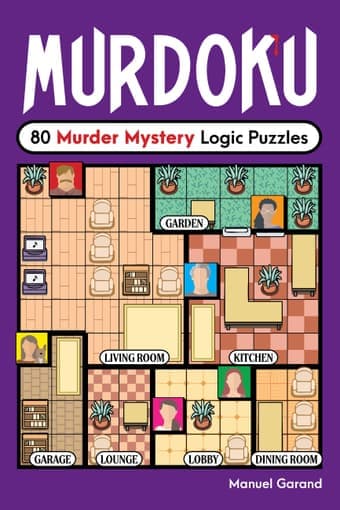
Murdoku
- Similar because
- One placement can rule out several others, as one assignment can do in Heist. Each of the 80 cases gives you an illustrated scene on a 9-by-9 grid. Clues about objects, rooms, and other people narrow the squares a suspect can occupy.
- Different because
- Each row and column can hold at most one person. Placing a suspect blocks those squares for everyone else, and the resulting positions reveal who was alone with the victim. The drawing is part of the logic, so you spend your time checking where someone can stand rather than deciding which role that person takes.
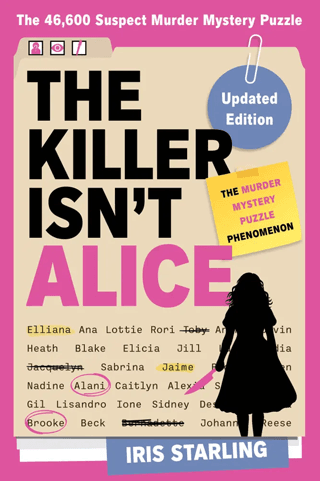
The Killer Isn't Alice
- Similar because
- A candidate has to survive several conditions at once, the same habit of mind that keeps a plausible Heist plan from falling apart. Alice gives you a dossier of 46,600 names and 18 clues. Some let you exclude a whole section at once, while others need a closer look at individual entries.
- Different because
- All that filtering serves one case. There is no fresh grid after each deduction, and a mistaken elimination can carry forward into every later pass. Heist gives you a new crew problem when a caper ends. Alice asks you to keep track of what you have already checked and return to the same shrinking list.
Murder Most Puzzling
- Similar because
- Like Heist, it gives you one problem at a time and lets the humor carry over to the next one. There are 20 illustrated cases. The work is to read the accompanying mystery, examine the picture, and test an explanation against the details you can see.
- Different because
- The illustrations can supply evidence rather than simply giving a puzzle its setting. With a Heist grid, you already know which categories to compare. Here you have to notice which part of a busy scene deserves a closer look, then decide whether it supports your reading of the case.
Cain's Jawbone
- Similar because
- A connection has to hold up against other evidence, whether you are assigning jobs in Heist or testing whether two passages belong together. Cain's Jawbone scatters its murder story across 100 fragments. A reference, a turn of phrase, or a hint about timing can give you a reason to put one fragment beside another.
- Different because
- This is the furthest departure from Heist. The prose supplies the clues without listing which ones matter, and the whole sequence has to make sense across six murders. It asks for close reading, patience with allusions, and a willingness to reopen a sequence that seemed settled. There is no run of short cases to build up to that one problem.
What kind of clue do you want to work with?
The Murdle books give each deduction a place on a grid. Murdoku gives it a place in a room, while Murder Most Puzzling leaves you to decide which detail in a scene counts as evidence. Alice keeps the same list of suspects on the table until the clues narrow it to one name. Cain’s Jawbone asks you to find an order for the story itself, so even deciding what comes next is part of the puzzle.
Murdle books in order · How Murdle, Murdoku, and Alice compare · G. T. Karber’s bibliography
Keep exploring
Explore another Books Like guide
Pick another book you know and see what to read next.