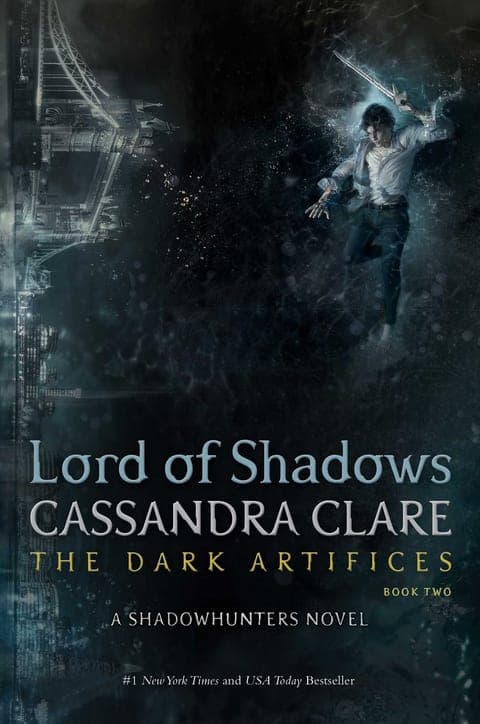
Reading Lord of Shadows closely
Lord of Shadows makes the Blackthorn family’s habit of keeping secrets increasingly difficult to sustain. Emma and Julian cannot solve their relationship by admitting what they want. Mark cannot simply leave his years in Faerie behind. The institutions surrounding them have demands of their own, and affection is a poor defense against an order backed by law.
The sequel is strongest when those pressures meet. A promise made to protect one person can endanger another; a private concession can become political leverage. This is a middle novel that widens the field rather than repeating the first book’s murder investigation.
Faerie makes every promise expensive
The search for the Black Volume of the Dead draws Emma, Julian, Mark and Cristina toward the faerie courts. The book matters because different people want different uses for its magic. Possessing it and understanding it are separate kinds of power, which gives negotiations more bite than a simple race for a valuable object.
The Cold Peace has left resentment behind it. Faerie’s danger is inseparable from that political settlement: an apparent favor may exploit a grievance the Shadowhunters would prefer to ignore. Clare gives bargains a social history, even when the immediate scene has the glitter and menace of a fairy tale.
The younger characters open another view
Kit’s place beside Ty and Livvy changes the emotional texture. His outsider’s suspicion meets a family whose habits are already established. Their investigations and tentative trust give the book a different rhythm from the older characters’ romantic anguish.
Dru also has to negotiate being young in a household where older siblings control information. Keeping these different ages visible is one of the trilogy’s strengths. The younger Blackthorns do not all react as smaller versions of Julian, even when they share the same danger.
Intensity, interruption and a heavy ending
The shifting viewpoints let Clare show a threat forming somewhere its eventual targets cannot see. They also keep interrupting one another. An urgent journey can give way to another relationship conversation just as the momentum begins to build. The novel’s breadth is productive, but it is not economical.
Emma and Julian’s divided loyalties remain credible because their family is at risk. Repeated attempts to deny or conceal the same feelings are less effective than the moments when those feelings change a decision. The romance works best as a source of compromised judgment, rather than a feeling repeatedly explained.
The final movement is severe and deliberately leaves its consequences for the third book. It earns force from the relationships already established, but it does not provide a comfortable place to pause. Lord of Shadows is a continuation with a cliffhanger, not an independent Faerie adventure.
Its place in the trilogy
Read Lady Midnight first. This book assumes its investigation, family revelations and romantic decisions; explaining the opening situation in detail would give away the earlier novel’s answers.
Continue with Queen of Air and Darkness. For a refresher after finishing all three, the Dark Artifices recap contains major trilogy spoilers. It should not be used as an introduction before a first read.
Make the next decision