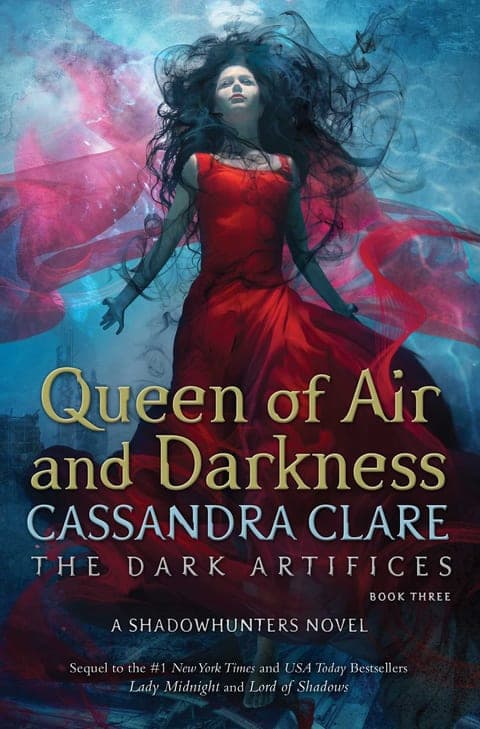
Reading Queen of Air and Darkness closely
Queen of Air and Darkness begins under the weight of the previous book’s ending. The Blackthorns are no longer trying to preserve an unstable normality. Their shared life has been damaged, and grief drives them toward incompatible solutions. Clare makes that division the engine of a finale whose scale is much larger than one family.
The central tension is between saving the people close at hand and rebuilding a community that has failed them. Emma and Julian’s bond cannot be disentangled from the laws around it. Neither can the family’s predicament be solved by a fight that leaves those laws intact.
Private grief becomes public danger
The Clave’s political conflict gives this conclusion a different shape from the murder mystery that opened Lady Midnight. The Cohort turns fear and resentment into a claim to authority. Its prejudice is sustained through procedure and institutional obedience as well as individual cruelty.
That makes the Blackthorns’ instinct to protect their own both understandable and insufficient. Secrecy can preserve a household for a while; it cannot establish justice for everyone outside it. The novel’s most interesting moral pressure comes from forcing those two scales of responsibility together.
The younger generation has its own unfinished story
Kit, Ty and Dru become more than people for the older characters to protect. Their decisions arise from attachments the adults cannot fully oversee. Ty’s concentrated attention, Kit’s uncertain sense of belonging and Dru’s frustration at being overlooked do not collapse into a single response to family crisis.
Those differences matter to the ending. Emma and Julian’s story is reaching a conclusion, while the younger characters are being positioned for one of their own. The change in emphasis is part of the novel’s design, although it sometimes makes the finale feel crowded with preparations for later books.
A generous resolution in an overfull book
Faerie, political resistance, magical illness and the parabatai problem compete for space. Clare keeps moving between intimate exchanges and spectacle, with little inclination to leave an emotional point understated. The generosity toward the cast is appealing, but some transitions ask a great deal of the reader’s attention.
The book is more convincing when a solution depends on a relationship already developed than when the accumulation of magical explanations takes over. Its treatment of belonging gives the large set pieces a human center. That does not make every strand equally persuasive or every resolution equally hard won.
The ending concludes The Dark Artifices without closing the whole Shadowhunter world. There are real answers to this trilogy’s central relationship questions, alongside political and personal consequences that survive them. Expect closure at one scale and unfinished business at another.
After the final Dark Artifices novel
Lady Midnight and Lord of Shadows are prerequisites, not optional background. Their major developments shape the first pages of this book, and this analysis deliberately leaves those developments unnamed.
The Dark Artifices recap (major spoilers) explains the ending and the characters’ positions afterward. The guide before The Last King of Faerie covers the wider reading sequence. Neither page treats an unpublished sequel as a novel already reviewed.
Make the next decision