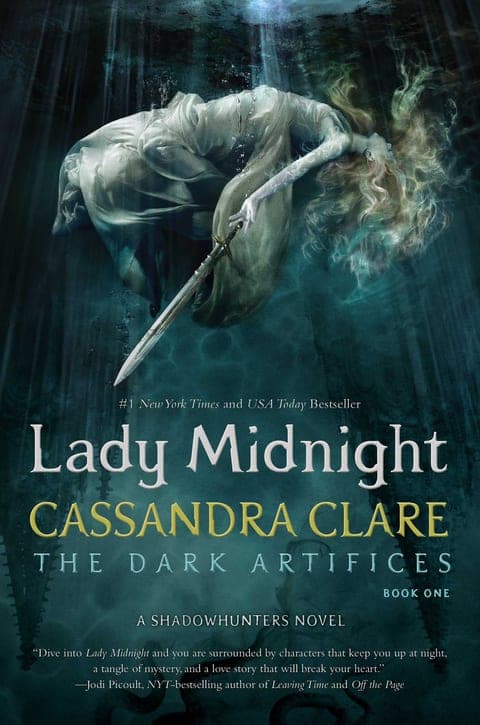
Reading Lady Midnight closely
Lady Midnight gives its demon hunters something harder to manage than a battle: a household. Julian Blackthorn’s younger siblings need food, supervision and reassurance. Emma Carstairs needs answers about her parents’ deaths. Those needs occupy the same rooms, and neither conveniently stops when the other becomes urgent.
That is the novel’s strongest distinction from City of Bones. Emma already understands the Shadow World, so the interest lies less in discovering its existence than in seeing how its rules bear down on people who belong to it. The Los Angeles Institute should offer protection. Instead, preserving that home requires secrecy from the very authorities meant to oversee it.
A murder investigation with two kinds of pressure
Newly discovered bodies carry signs that remind Emma of her parents’ deaths. The investigation moves through a Los Angeles where beaches, roads and ordinary nightlife coexist with hidden violence. Clare uses the coast especially well: open water does not make this a freer world. It supplies another border the characters cannot safely cross.
Mark Blackthorn’s temporary return from the Wild Hunt brings a bargain into the family’s relief. Solving the murders may help keep him home. His difficulty fitting back into family life prevents the reunion from becoming an easy reward. The investigation therefore has an immediate practical cost as well as Emma’s much older, private one.
Julian’s care is also a form of control
Julian is compelling because his competence has an unpleasant edge. He has learned to make decisions for other people before they can object, and keeping the children together can become a justification for withholding information. The novel allows tenderness and manipulation to occupy the same character.
Emma’s determination is more outwardly combative. Their parabatai bond makes them trained partners, while its prohibition on romance turns their intimacy into a threat to the arrangement that keeps them close. The problem is built into their shared daily life, rather than arriving only when a villain intervenes. Cristina’s presence gives Emma a friendship outside that closed circuit.
Where the book gains depth and loses speed
The family scenes give the mystery weight, but the large cast demands room. Introductions, romantic complications and explanations of the Cold Peace repeatedly interrupt the pursuit of a killer. The investigation is not a compact puzzle in which every scene advances the case.
Clare’s prose alternates fast exchanges and banter with emphatic declarations of longing. That register suits characters living under extraordinary restrictions. It can also overstate a feeling that a smaller gesture has already made clear. The strongest passages trust the conflict between a person’s public duty and private need to do the work.
An opening novel with inherited history
The murder plot supplies a shape of its own, but Lady Midnight opens a trilogy. It establishes relationships whose consequences need the next two books. The setting also follows City of Heavenly Fire, so starting here means accepting references to a previous war and established characters without seeing their full histories.
The reading guide before The Last King of Faerie separates that shorter route from Clare’s full series sequence. Continue this trilogy with Lord of Shadows. The supernatural murders, coercion, violence and romantic conflict are integral to the story; its domestic warmth does not make the danger gentle.
Make the next decision