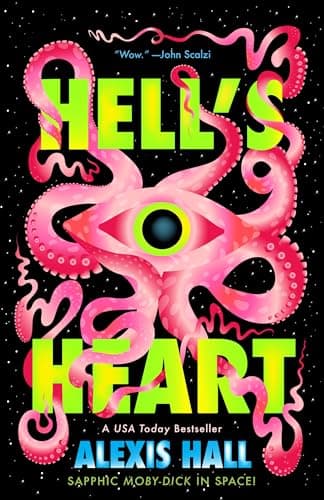
Should you read Hell's Heart?
What works
Jupiter's psychic leviathans turn whaling into grotesque resource dependence, while the profane narrator's connection with Q gives the voyage something vulnerable to destroy.
What may not work for you
The self-aware voice can strain for irreverence, and readers unfamiliar with Melville may find some structural echoes more conspicuous than useful.
What may test your patience
The Pequod's economy, crew, and harvesting practices take time to establish before the captain's obsession fully controls the journey.
Does the ending reward the effort?
Yes. It preserves the tragic force of its model while making the emotional and political cost specific to this future.
Reading Hell's Heart closely
Hell's Heart reimagines Moby-Dick in a ruined solar system where civilization depends on cerebrospinal fluid harvested from enormous psychic leviathans in Jupiter's atmosphere. A broke, restless narrator joins the Pequod for money and is pulled into the orbit of an obsessive captain.
Alexis Hall combines a profane, self-aware voice with space opera, queer desire, corporate ownership, and the terrible economics of survival. The narrator's connection with Q offers a possible anchor, but the hunt keeps turning bodies, monsters, and relationships into fuel.
Moby-Dick above Jupiter
The names and obsessive hunt are deliberate, but the retelling transforms whaling into a future extractive industry operating inside a gas giant's storms.
Three useful comparisons
Moby-Dick
Moby-Dick is more formally digressive and encyclopedic; Hell's Heart is faster, queerer, and explicit about the corporate economy supporting the hunt.
Best for: Patient readers who enjoy maximalist classics, maritime labor, philosophical comedy, and books willing to abandon plot for inquiry.
Shards of Earth
Shards of Earth offers a broader found-family adventure against planet-scale beings, while Hall keeps the voyage tragic and the resource economy central.
Best for: Go here for a found-family crew, diverse aliens, political factions, salvage work, and large-scale space-opera danger.
Eversion
Eversion uses repeated expeditions and reality shifts for controlled mystery; Hell's Heart is louder, bloodier, and driven by obsessive pursuit.
Best for: Pick this for standalone science fiction, unreliable reality, exploration, artificial intelligence, and a strong late reveal.