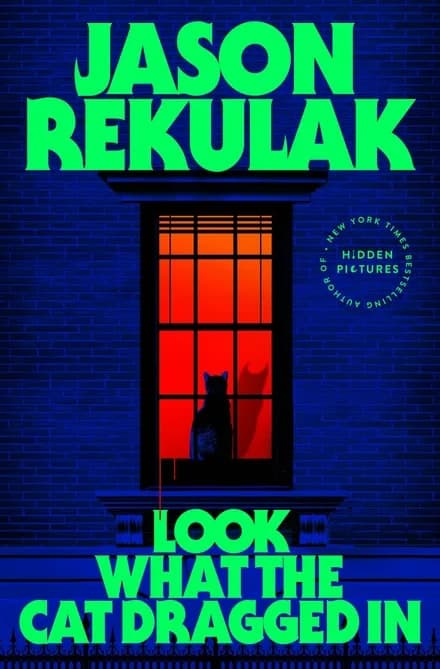
A cat that makes itself at home
Godfrey follows Penny Padgett around the house and wants to sleep beside her. The affection makes it hard to tell when having him close stops being a comfort. Penny is a Philadelphia cartoonist, and one place you can see her life changing is in the work she puts on the page.
What is Look What the Cat Dragged In about?
Penny is twenty-seven and already has a cat in her working life. Popcorn is the model for the pet in her comic strip. The novel opens with Popcorn missing just as a blizzard bears down on Philadelphia. By the time Penny agrees to look after Godfrey, it is easy to see why a friendly cat might be welcome company.
Then Penny starts having violent dreams. Insects take over the basement, her health worsens, and the cartoons she normally makes for a young audience begin to look like something she would never have intended to draw. She has to sort out what she can trust while she's feeling worse.
What makes the story unsettling?
The opening gets a lot out of a kitchen window. Penny remembers shutting it before leaving for the store. When she comes back, it is open, the house is cold, and Popcorn is gone. A little lapse in memory would explain the window. That possibility is alarming enough when a cat is missing and snow is about to make the search much harder.
Rekulak can build on that kind of doubt because he gives Penny familiar things to worry about first. A pest problem belongs to a house, a nightmare belongs to sleep, and a bad drawing belongs to work. Once all three turn up in the same stretch of her life, it gets harder to keep each problem in its own little box. Godfrey can be a sweet companion and still make that pattern hard to ignore.
The illustrations carry clues
The book has more than eighty pages of artwork. Doogie Horner draws Penny's comics, including the strip about her life with Popcorn. Seeing that gentle version of her work gives you a baseline. When the panels take a darker turn, you can look for changes yourself instead of relying on Penny to tell you how far they have gone.
Will Staehle makes a second kind of image, collages in the style of nineteenth-century engravings. Those pictures have a different job. They give the mystery a past and let some of that history reach the reader through images instead of a long explanation. The comics raise questions about what's happening to Penny now. The engravings give you reasons to look further back. Both can put a clue in front of you before you know what it means.
As an Amazon Associate, I earn from qualifying purchases.
Penny has a life beyond the mystery
Penny is funny company even in the opening search. She has pet names for Popcorn and knows to check the laundry hamper and the top of the printer. When she runs out of hiding places to look, it's her friend Margo she reaches for. Those small habits make her attachment to Popcorn feel ordinary and lived in.
It matters that Penny makes things for a living. Losing sleep would be bad enough on its own. When she starts to mistrust the pictures she produces, the trouble has reached a part of her life where she usually knows what she's doing. That's a more particular loss of confidence than being stuck in a creepy house with a cat.
What the picture clues ask of you
The comics give the book a way to get a laugh and then make you uneasy with the very same drawing style. They also change how you follow the mystery. A page with a picture may take less time to read than a page of prose, but it gives you something to stop over and compare with an earlier image.
That extra pause is part of the pleasure if you enjoy looking for clues. If you're mainly after the pressure of a suspect interview or a tightly bounded whodunit, the change of medium will feel like a detour. Penny's story spends its time on the more slippery question of what she can trust about her own experience.
Is Look What the Cat Dragged In scary?
The fear is close to home. Bugs turn the basement into somewhere you'd rather avoid, nightmares make sleep unreliable, and an inviting cartoon can hold something nasty. The bodily unease matters as much as the idea of a supernatural presence. If insects or disturbing images get under your skin, a joke about a cat will only take the edge off for so long.
What Freida McFadden singled out
Freida McFadden called this “One of my favorite books of the year” in praise published by Macmillan. Her recommendation singles out the suspense of Rekulak's supernatural thrillers and the return of the kind of artwork she admired in Hidden Pictures. The pictures can tell you something Penny hasn't put into words.
Final thoughts
Penny's work gives the mystery a trace you can follow. You get to see what her everyday world looks like when she draws it for children, then watch that same familiar world come out wrong on the page. It is an unusually literal way to show someone losing confidence in what she sees. For other stories that use artwork, an unreliable house or a sickening physical clue to build fear, see six books like Look What the Cat Dragged In.