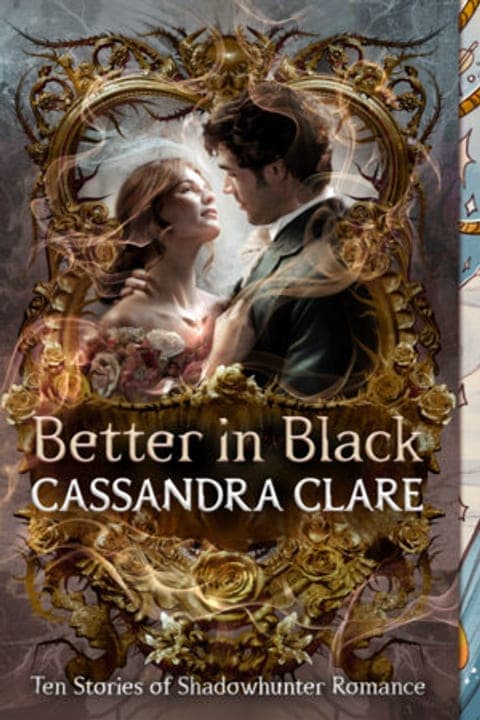
Reading Better in Black closely
Better in Black changes the question from what happens to the Shadowhunter world to what another evening, journey or complication might mean for a familiar relationship. Its ten stories return to established couples across the series. The attraction is proximity to those people, rather than a single new conflict holding a novel together.
That distinction is also the collection’s limit. A reunion can carry emotional weight only if the earlier books have supplied it. These stories do not recreate every relationship from its beginning, and their movement between periods makes them a poor first encounter with the series.
Romance after the introductions are over
Jace and Clary, Will and Tessa, Simon and Isabelle, and Emma and Julian belong to different stretches of Shadowhunter history. Bringing them into one collection makes the continuities of Clare’s romantic writing easy to see: loyalty under pressure, danger entering private time, and declarations tested by a specific inconvenience or threat.
Will and Tessa’s Paris honeymoon acquires a supernatural complication through a séance. Simon and Isabelle follow increased demonic activity through New York, while Jace and Clary seek an exiled Shadowhunter. The settings give the couples different kinds of shared work: a private holiday interrupted, a city to investigate, a person to find. That variation matters more than collecting another declaration from each pair.
The shorter form can give those encounters a welcome concentration. It can also make the risk feel temporary beside relationships that have already survived full novels. The interest often comes from the characters’ responses to each other, rather than uncertainty about whether a whole world will be saved.
The pleasures and limits of a reunion collection
Clare’s banter has room to operate without supporting a long investigation. A shift in setting or an awkward exchange can carry a scene. The writing is less persuasive when emotional explanation crowds out those small differences and makes several relationships sound as though they are expressing the same intensity.
The collection’s shape is discontinuous. One pair’s situation gives way to another, and attachment to particular characters will inevitably make some transitions more welcome than others. That unevenness belongs to the format, but it also limits the cumulative force a single novel can build.
The premise includes darker material as well as affectionate reunions. A story involving Sebastian and the Seelie Queen does not promise the same emotional register as an adventure for a settled couple. The word romance should not be taken as a guarantee of uniformly comforting stories.
Read it after the stories it revisits
The collection assumes relationships formed in The Mortal Instruments, The Infernal Devices, The Dark Artifices and The Last Hours. Even without retelling their endings at length, the pairings can reveal where earlier romantic plots lead. This analysis leaves the stories’ outcomes alone.
Better in Black includes a preview of The Wicked Powers. That gives it a connection to the next trilogy, not the status of a required volume between Queen of Air and Darkness and The Last King of Faerie. A preview cannot replace the earlier novels’ character development.
The preparation guide places this collection among the companion readings. For the actual events of the preceding trilogy, use the Dark Artifices recap only after finishing the trilogy.
Make the next decision