Reading order
Dune books in order and which edition to buy
Start with Frank Herbert's Dune, not an in-universe prequel. Buy the first novel alone unless you already know you want the full six-book argument.
The short answer
Read Frank Herbert's six novels in publication order
The order is Dune, Dune Messiah, Children of Dune, God Emperor of Dune, Heretics of Dune, and Chapterhouse: Dune. Do not begin with a chronological prequel. The first novel teaches the political, ecological, and religious ideas that later books question.
Dune has expanded into enough prequels, interquels, sequels, short stories, and branded editions to make a simple purchase look like research. New readers do not need the full chronology. Frank Herbert wrote six Dune novels, and their publication order is the strongest first path because each book responds to the consequences and interpretations of the previous one.
The six are not six versions of the first novel. Dune begins as a political survival story with ecological scale. Messiah is shorter and deliberately suspicious of heroic legend. Children expands the family and imperial consequences. God Emperor makes a radical time jump and becomes more argumentative. Heretics and Chapterhouse rebuild the field around later institutions. A reader may reasonably stop before all six.
The choices
Frank Herbert's six-book order
Only the first novel currently has a full review in our catalog. The remaining entries are included to establish the correct order, not to imply that we have reviewed editions we have not examined.
1
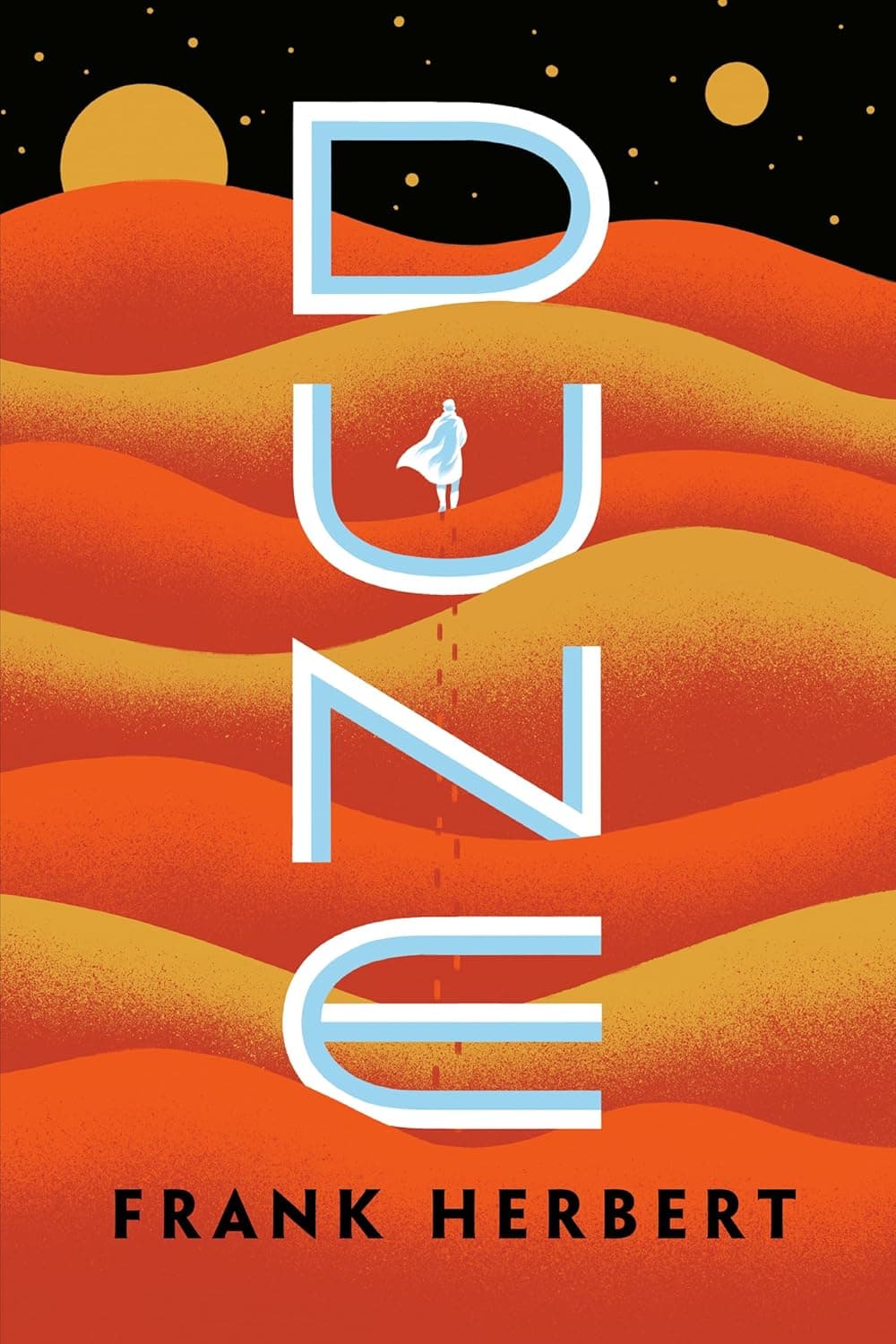
Dune
The required beginning
Paul Atreides enters a political trap on Arrakis, where water, spice, ecology, religion, and imperial extraction are parts of the same system. The book establishes terms through context rather than pausing for neutral explanation.
Buying decision: Buy this alone first. It has a complete large arc and gives enough evidence to decide whether Herbert's style and ideas suit you.
2
Dune Messiah
The necessary correction
The shorter sequel examines what power and prophecy do after apparent triumph. Readers expecting another desert adventure often resist its political confinement, but its skepticism is central to Herbert's project.
Buying decision: Read it if you want to understand what the first book is arguing about hero worship, not only what happens to its characters.
3
Children of Dune
The close of the first broad movement
A new generation inherits political myth, ecological transformation, and choices that cannot be reversed. It restores a wider field of movement after Messiah while preparing a much stranger future.
Buying decision: Stopping after this book gives a more substantial trilogy-shaped experience, although important consequences remain open.
4
God Emperor of Dune
The great change in form
A vast time jump produces the most philosophical and polarizing novel in the sequence. Conversation, political design, and a ruler's long argument matter more than conventional adventure momentum.
Buying decision: Do not buy books four through six merely because you enjoyed the first film adaptation. Continue because Herbert's critique and historical scale interest you.
5
Heretics of Dune
A later-world reconstruction
New powers and returning institutions operate in a world shaped by the God Emperor's legacy. The novel is more kinetic than book four but assumes that its historical transformations mean something to the reader.
Buying decision: Read after God Emperor, even if the time jump makes a summary tempting.
6
Chapterhouse: Dune
Frank Herbert's final Dune novel
The sixth book continues Heretics closely and ends with unresolved movement rather than a sealed conclusion. That incompleteness belongs in the purchase decision.
Buying decision: Buy it as the end of Herbert's authored sequence, not as a promise that every thread will close.
Side by side
Which Dune edition should you buy?
A different cover rarely means a different novel. The useful edition question is how a long, terminology-heavy book feels in your hands and whether you want one volume or a coordinated set.
| Edition type | Best for | Tradeoff | Buying advice |
|---|---|---|---|
| Mass-market paperback | Lowest-cost, portable first read | Small type, tight margins, stiff thick spine | Good test copy if your eyesight and hands tolerate compact books |
| Trade paperback | Comfortable sustained reading | Costs more and occupies more space | Best default print choice for most readers |
| Standard hardcover | Durability and repeated reference | Heavy for a long novel | Choose it when the book will stay on a desk or shelf |
| Deluxe or illustrated hardcover | Display, gifting, collection | Premium price can exceed any reading benefit | Buy after you know you value the novel |
| Six-book matched set | Readers committed to Frank Herbert's complete sequence | Large upfront purchase and later books differ sharply in style | Do not make this the default first purchase |
| Ebook | Adjustable type, search, travel | Maps and appendices can be slower to navigate | Best accessibility choice when print density is the obstacle |
Where can you stop without reading every Dune book?
After Dune
You will have a major, satisfying novel. You will not see Herbert's sharpest correction of the heroic interpretation many readers take from it.
After Dune Messiah
You will have the rise and immediate cost in a compact two-book arc. This is our preferred minimum for readers interested in the argument.
After Children of Dune
You will have a broad first movement across generations before the sequence's largest time jump.
After Chapterhouse
You will have all six Frank Herbert novels, but not a conventionally closed finale.
What about the expanded Dune chronology?
The official Dune site maintains a much larger in-universe chronology that includes books and stories by Brian Herbert and Kevin J. Anderson. It is useful as a reference after a reader understands the major periods. It is not our recommended first reading order.
Chronological order begins before the novel that created the world and explains institutions before their dramatic introduction. Publication order lets Frank Herbert decide what is mysterious, what is historical, and when a reader should revise an earlier belief.
Quick answers
Questions readers ask before buying
How many Dune books did Frank Herbert write?
Six: Dune, Dune Messiah, Children of Dune, God Emperor of Dune, Heretics of Dune, and Chapterhouse: Dune.
Should I buy all six Dune books at once?
Usually no. Buy Dune first unless you already know that Herbert's increasingly philosophical and historically expansive direction appeals to you.
Is chronological order better for Dune?
Not for a first read. Start with Frank Herbert's original novel and follow his six books in publication order. Use the expanded chronology later as a reference or rereading project.
Sources
Sources for this guide
Order, series status, and official starting-point claims were checked against these author and publisher pages on August 2, 2026.
Keep reading